
We use our day of clothes drying to also have a look round the town – there’s an 18th Century tower, a small monastery, and the first electric locomotive in Georgia on display near the train station. We also find a really nice cafe; a huge bonus, since Italian-style coffee is hard to find here.
It’s a bit rainy when we leave, and we’re bracing for the worst again. But not only does it stay dry, but it’s one of the best days we’ve had for a while. The scenery is really beautiful; we probably haven’t been on such a scenic route since Switzerland. We see a couple of ancient fortresses, pass through little villages and I get to see more huge Soviet monuments.
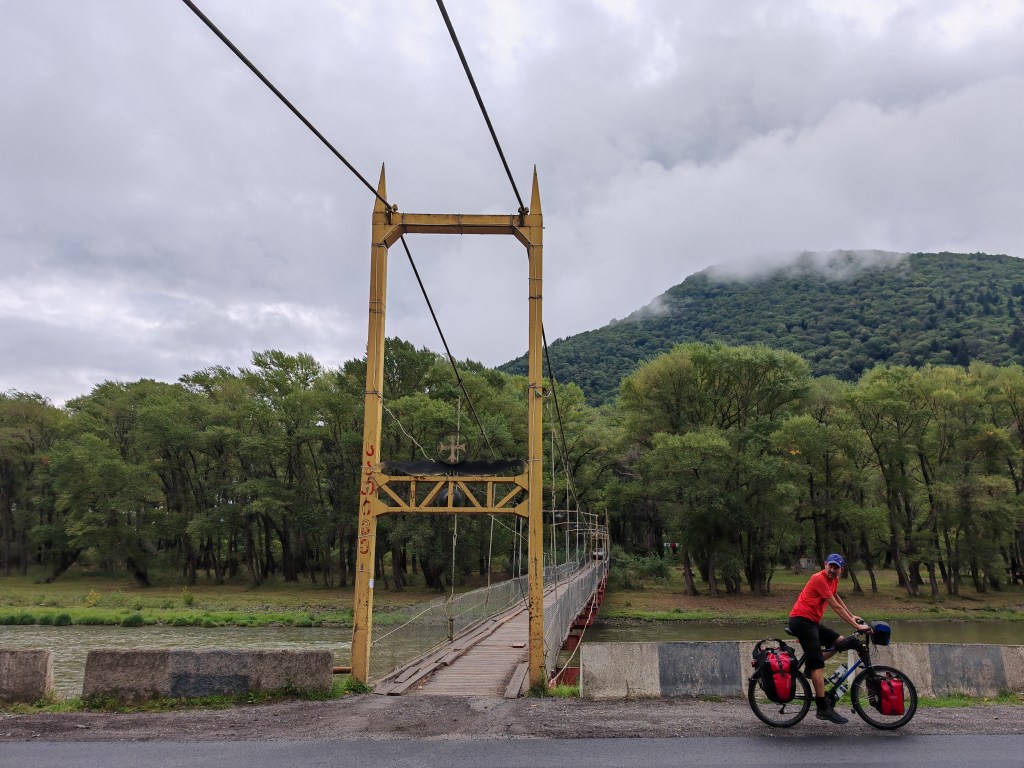
We arrive in the spa town of Borjomi, and stay at what would in Central Europe be termed a pension, run by an elderly woman called Anna. She shows us to our room which is decorated like a chintzy Russian boudoir. She warns us not to shut the bathroom door, because the lock is broken and if the door closes we’ll be shut in. She gives a warning tale about someone this morning that it happened to, and she could only get them out by calling someone. We both shower and remember to leave the door ajar.
Later that afternoon I use the loo, and as I spy the foot towel on the floor I think that I must remember to roll that up and put it against the door frame, so the door doesn’t shut. And then I realise that it is already shut, because I have forgotten not to shut it. Richard’s reaction is sour, at best. He declares, from the other side of the door, that there’s no way he is going to tell Anna that I have locked myself in the bathroom, when she told us not to do this. It’s an interesting situation, because no one else can tell her that I’m locked in the bathroom, and she will find out eventually anyway. Finally, after some stomping and swearing, he goes to get Anna.
I imagine that the person she calls will be a locksmith, and I will be on the hook for the cost of that, but it will be worth it to get out of the bathroom. That thinking is just so UK. The person she calls is her mate, who is a woman wielding an axe. The door opens to me facing the woman with an axe, who has used it to break the lock. I wave lamely and say “Hi,” she looks unimpressed and doesn’t say “Hi” back. Anna is expressionless, and says to me with a deadpan face “Don’t shut the bathroom door.”
The towel goes against the door frame, and I don’t shut it again.
We arrange to meet up with Fede and Baaska, who are staying a couple of nights to also catch up with drying. They have intel from their host about some Soviet era relics in the train station, so we head there. We are 4 minutes too late to get inside the old station, but we can peer through the glass and have a look at the old wooden departure boards and timetables.
After that there is the spa town to see. The sulphur spa water is very famous – it gives its name to a major water brand in Georgia – and drinking from the natural spring is said to have enormous health benefits. We are all too cheap to pay to get inside the gardens, where there are taps of spring water to drink from. But we find a spigot of it in the free part. It tastes a bit like burning sweat.
We exchange travel stories and thoughts on Georgia over some wine later. One thing we’d been noticing is that there are loads of righthand-drive cars here. Fede confirms he’s read that Georgia is a well known outlet for cars written off in the UK. We’ve also noticed that an incredible number of cars have huge amounts of damage to them – often entirely missing front ends, so this also makes sense. We also discuss the lack of friendliness here, which is very noticeable. It is apparently considered suspicious to greet strangers with a smile. Georgians see this as insincere and inauthentic, with smiles reserved for people you feel genuine warmth towards. It helps to have context for these cultural differences.
The next day is more of the best cycling days we’ve had for months. The scenery is like a painting, and full of wonders around every corner. We stop to sit by a river carved through a gorge, and then wind up through the incredible hills.
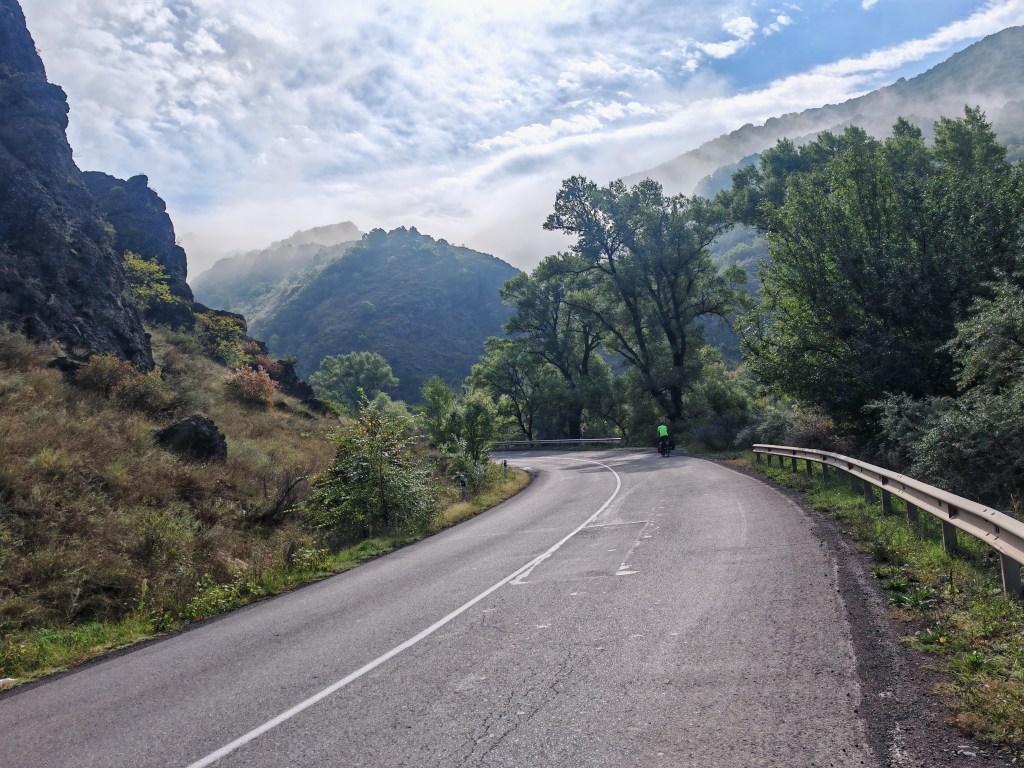
We have plenty of time in Georgia, so we are liberal with our days off, and determined to enjoy the places we stop in rather than just passing through. In Akhaltsikhe we stay to look around Rabati castle. Parts of it date back to the 9th century, but has been expanded since and underwent a major reconstruction more recently. That has been severely criticised as a Disneyfication of a historic monument. That’s definitely true, and some parts feel gaudy, though much of the core is more tasteful. The mosque on the middle level is genuinely preserved (though out of use,) and the surrounding gardens are stunning, as is the view. The upper castle is original, but like a badly thought out Minecraft build, with stairs and walkways that go nowhere. The Samtskhe-Javakheti museum on site has some notably rare manuscripts and tapestry, so I’m happy enough.
We find an underground tavern for dinner, and can’t believe how good the food in Georgia is, or how cheap and great the wine.
The next day we head to a brewery, which also has rooms to rent. It’s very rural, and as always, Richard is convinced we are going the wrong way. He is instantly tetchy when we get off the beaten track. I have to admit that the location seems so unlikely that I start to have doubts, until we see an old beaten sign. The woman who lets us in could either not be expecting us, or be in a mood, or just be Georgian. It’s really hard to tell. She does seem to indicate that someone more helpful might be along later.
We venture back out to where we assume we should be if we want beer, and through some pointing and translations we each order a large “tree” of different beer, so we can try them all. The last time I had a “tree” of drink it did not end well, but the beer is mostly lovely.
We’re slightly worried about food, because the place is in the middle of nowhere, and though dinner was advertised we are the only ones staying here. But the couple who own the brewery arrive in the late afternoon, hand us a menu and offer more beer. We’re told that as we both ordered the full tasting sets, we can each pick our favourite and have as much more as we want of it, on the house. In my twenties I would have jumped at this, probably ended up swimming in the river later, woken up in the bathroom and not cycled the following day. Today we both agree that we’ll have a couple more pints, but that’s it. We have some really big climbing the following day. We explain this to the owner, but his reply is just “but you can just go slow.”
We do go slow, because the climb lasts almost all day, but it’s a manageable gradient and the scenery is stunning again. We stop at a layby to admire the views, and we’re greeted by a Kyrgyz lorry driver, who asks us to join him and his companion for breakfast. They have flatbreads, jars of olives, a couple of kinds of cheese, sliced tomatoes and cucumber, and of course several rounds of chai. He is scathing (in mime) about the state of the Georgian roads up ahead for us, but our perception of distance on a bike is not the same as his in a lorry, and we won’t encounter his complaints on this day.
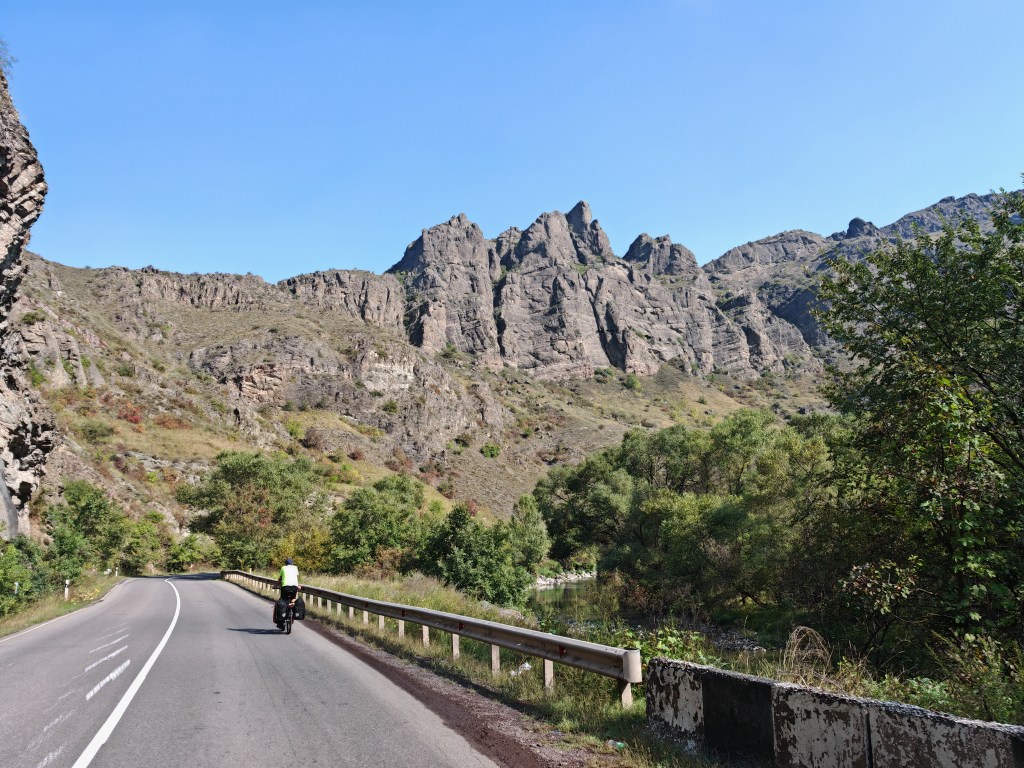
We do pass another ancient fortress, and run out of superlatives for the views. There’s a confluence of two rivers here, and a deeply cut gorge by one of them. The scenery seems computer generated, it is so unreal.
At the end of the day my heart sinks when I see that we have a few steep switchbacks to get to the town we’re staying in, but we take them in our strides. I think we are probably as fit now as we’ve ever been and it means we’ve been able to enjoy the climbing and appreciate what we see.
We’re staying in a very odd hotel in a very small place. We are very obviously outsiders, and it generates stares and whispers. I wonder what it is that marks us out (when we’re off the bikes,) but it’s probably the fact it’s just a small town with few visitors.
We are here for two nights for Richard to get some work done, otherwise this wouldn’t be such a rest day. We are greeted, in the very loosest sense of the word, by a gruff old man who looks more like he forges iron with his bare hands than runs a hotel. We are the only ones here, and all the doors to the hotel are open, so when we find that we only have one tiny towel between us, I am able to creep around and get another, rather that ask the ogre downstairs.
In the morning we make our way to the kitchen, where the ogre barks at us to sit at the counter, while he chops tomatoes in front of us as though we will be next, almost throws a couple of cups at us as he points at the kettle we can use and chucks a bag of bread on the counter before stalking off.
The day off gives us a chance to visit the Armenian church and take a walk through the park. We are desperately trying to find somewhere to have a coffee, but usually the best Georgia does is from a vending machine, or at kiosks who use the instant version. We are hovering around one of the vending machines outside a restaurant which looks shut, when out comes a woman who bustles us inside and serves us coffee there. We go back there later, and she hands us a menu. We point to the things we want, but she shakes her head at everything and says “but we have kebabs.” The kebabs are really, really good.
The next day our host has warmed somewhat. He serves breakfast a bit more softly, and insists on making us some Armenian coffee, smiling when we say we like it and then seeing us off.
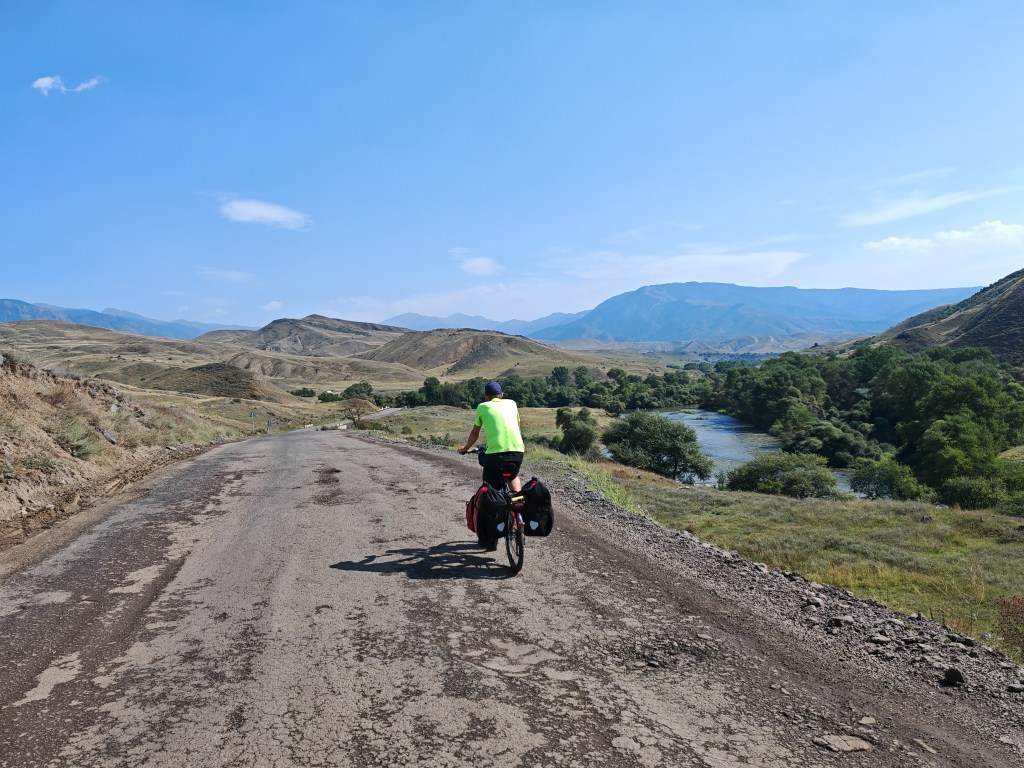
We’re staying at an even smaller town the next day. The landscape now is less dramatic and more agricultural. On a walk around in the afternoon we spot a vintage fire engine, and with very out-of-character assertiveness, Richard strides over to the firefighters and asks if we can take photos. They ask us not to post pictures online, but after that are chuffed we are interested in it.
On the way out it’s clear that this is an achingly poor part of the country. There are many homes with grass roofs to insulate them, and children shaping dung bricks to be burned as winter fuel, with rows upon rows of them out drying in the sun.
We’ve climbed so much from sea-level Batumi, and are now on the high altitude plains. We’re heading to the border crossing with Armenia at 7,000 feet, and another new country.
A playlist for the ride:


Leave a Reply