
We have mentally split our time in Turkey into four phases, and the first is getting through the long, relentlessly hilly, and fairly dull section from the border to the Sea of Marmara.
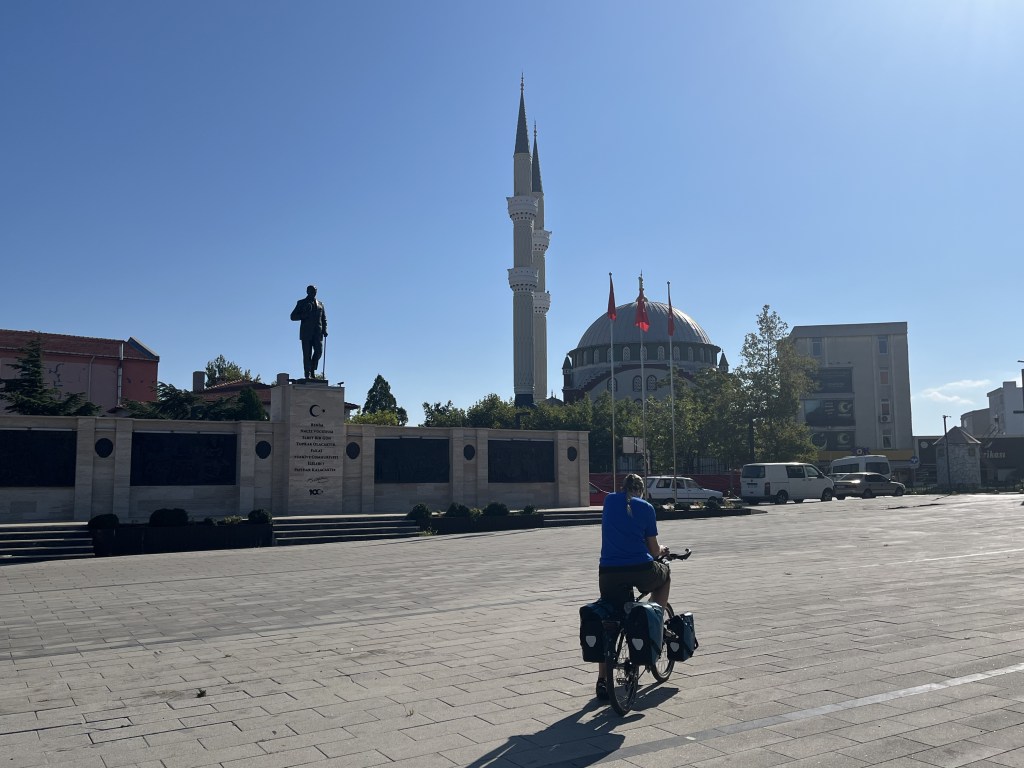
We are slightly ripped off for our first meal, and Richard whangs on about it for weeks. But twice in two days when we stop for tea we are waved away when we try to pay, the food is really good, and Turkey’s Tadelle is the greatest chocolate bar in the world.
On our third day, I have a bad dog experience. Dogs are an expected menace in Turkey, though usually they are just a nuisance, and nothing more. You get to know when a chase is by a bored and mostly harmless dog, and when one means you harm. A very large dog spots me from a long way off and makes a beeline, and I know from the snarl and the look that this is a mean chase. And I know that all the advice is to go slowly, shout, get off if you need to and put your bike between yourself and the dog. I am doing the first two things and the dog is completely insane with wrath anyway, but I have armco between myself and him so it’s fine. Until I see a gap in the barrier appear, so does the dog, and there is no way I am getting off the bike, whatever the advice is. I feel one rear pannier being jerked around in that ragdoll shake as the dog has its teeth into it. I’m on a section of downhill, so I get away once he lets go, but it’s a blur. The panniers are tough things, but there’s teeth punctures and a tear. And I’m really shaken up.
The headwind continues to blast into us across Turkish Thrace, so we’re relieved and excited when we descend to the sea and the town of Tekirdag on the western Sea of Marmara. Our next target now is to clear Istanbul by taking a series of ferries, which should get us past most of the bad traffic and have us on our way properly east.
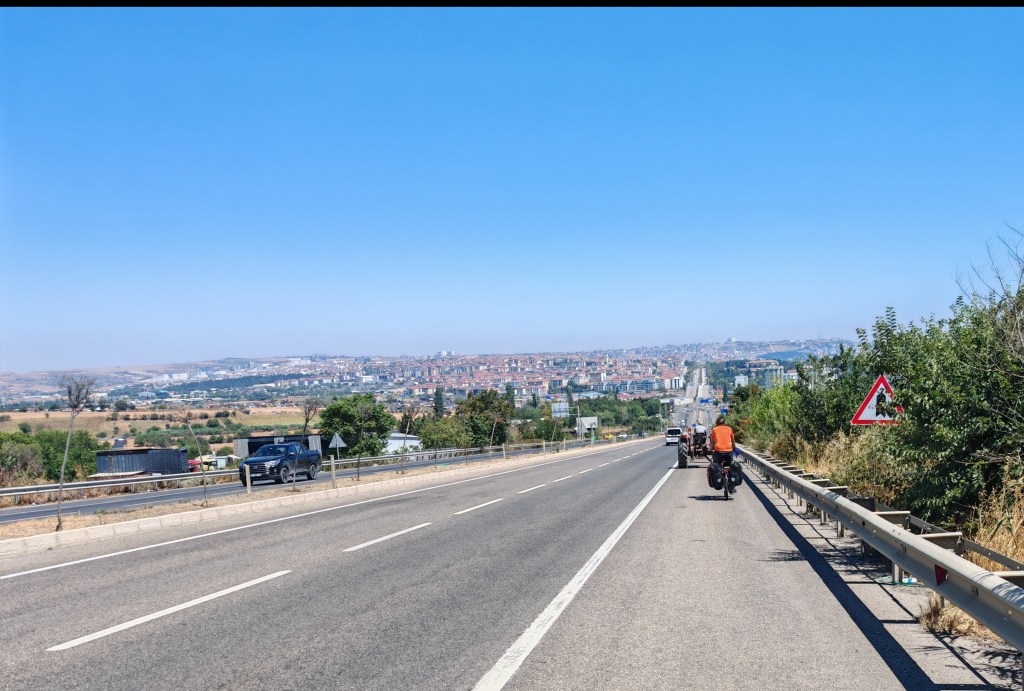
We aren’t getting the ferry on the day we arrive in Tekirdag, but we go to the ferry terminal to make sure it’s viable. There’s very little information about the route from here to Bandirma online, so it’s the part we’re not certain of. The woman at the ticket counter is very helpful. She sees the bikes and assures us that it’s no problem. We can’t buy tickets the day before, but that’s okay. The ferry the next day doesn’t leave until 4pm, and online sailing times have the crossing anywhere between two and five hours. We book a hotel in Bandirma, because we won’t be arriving until late.
The following afternoon we arrive again at the ticket office. We show the bikes again. Again no problem. But we need to come back in an hour because tickets aren’t available yet. The third time, the same woman at the counter tells us that we can’t actually take the bikes on the ferry to Bandirma, but the ferry we can go on is to Erdek. She’s quite casual about this, and to a non-cyclist maybe it doesn’t seem a big deal, but it’s twenty kilometres between the two, over hills, the ferry arrives late and if we’d been told this before we would have booked a hotel in the place the ferry actually goes to.
Things start out brightly. The ferry seems quite fast, and Richard thinks we’ll be there in a couple of hours. But the wind builds and builds and it feels like we’re going nowhere. We find out there are two stops. We get to the first at nearly 7pm and are told we will wait here for an hour while some lorries are loaded. When we set off again the wind is so strong that we barely move. Time and the sun slips away. I am dying for the loo, but I take a look at the toilets on board, and decide I can wait. We dock at 10pm in full dark.
We set off in the dark on a main road, after letting all the lorries go off ahead. It’s okay at first, until we start to climb on a busy main road, which is completely unlit, and with no shoulder. My front light isn’t working, so I can only follow Richard’s rear light, until he pulls away. It’s terrifying not being able to see the road ahead at all. I have no idea where the white line is, or if there’s a ditch the other side, if there’s glass on the edge (there often is here.) It’s actually good when there are cars right behind me, because I can get a look at the road in front from their headlights. Near the top a petrol station is just closing up for the night, but the attendant lets me use the loo, which is a massive relief.
After that, the road is lit better and the surface improves, and we make decent ground into the city. There’s a bit of a wrangle about the bikes going inside, but it turns out to be a misunderstanding that we have motorbikes rather than pedal bikes.
We finally get to our room, and even though it’s been a hot and sticky few hours, for the first time ever I decide something is more important than showering after a bike ride. It’s late, and we haven’t eaten since the morning. We find a fast food pizza place, and it’s the only thing still open at gone midnight.
The next two ferries go far more smoothly. They are standard passenger crossings on common routes, and we hop from Bandirma to Yalova, via Istanbul. We are not completely free from the sea of Marmara, or the busy roads which encircle it, but we assume we’re far enough east that the traffic won’t be an issue. We are very wrong.
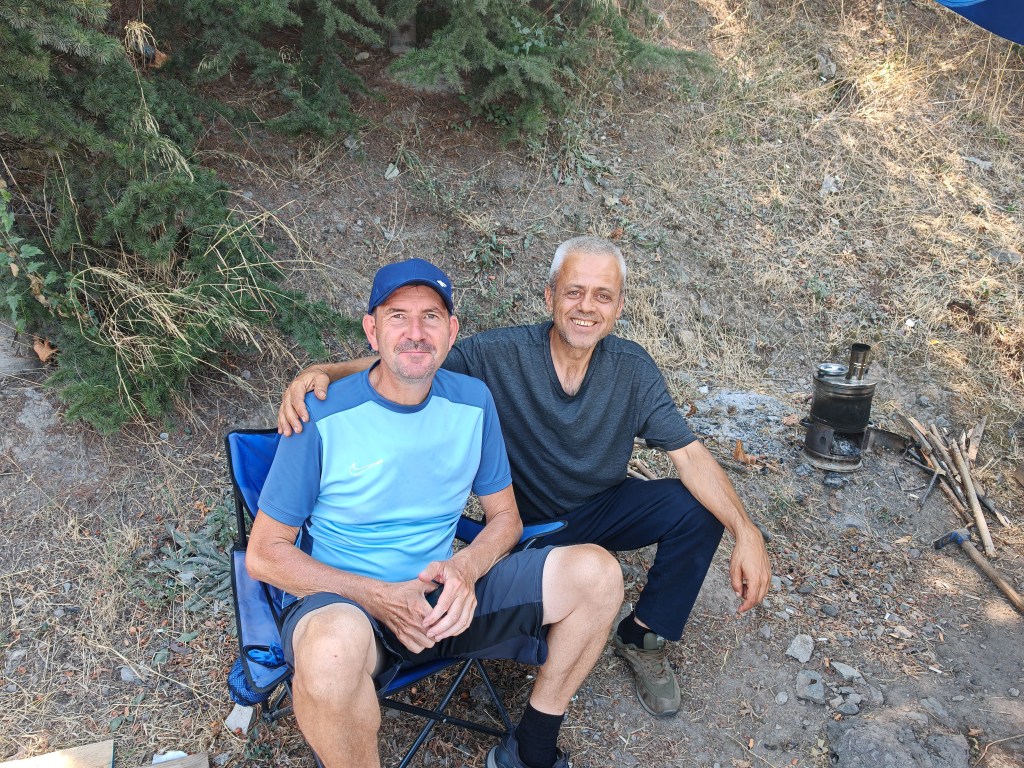
Early in the morning we are flagged down at a roadside stall. Abidin is selling fruit and edible acorns by the side of the road, and he invites us to have tea with him. He sets up places for us to sit, gives me his last biscuits, and plies us with tea and acorns. Eventually we have to go, but amongst the tough time we are having in the heat and traffic, it’s a nice reminder of the heart of Turkey.
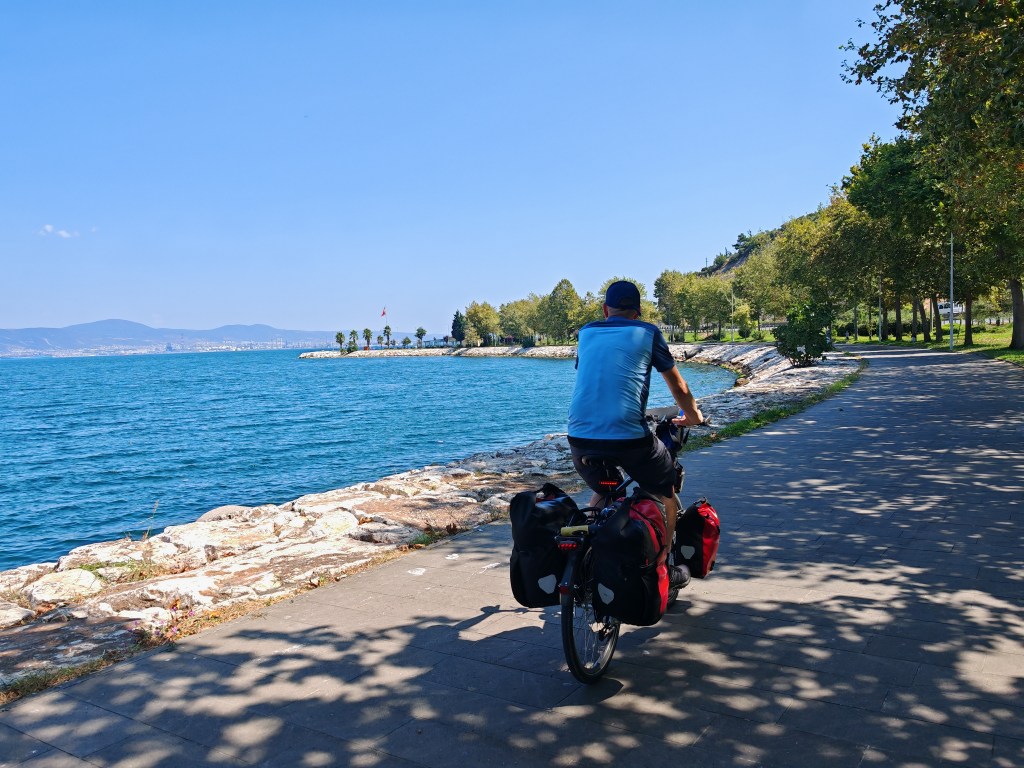
Nothing can make the cycling better though. We aren’t even on the major road – the expressway mirrors the road we’re on – but the interminable junctions to get onto it and into the string of towns and cities, mean we are constantly having to cross joining or leaving traffic, most of which are lorries. It’s boiling, the wind doesn’t let up and I am thoroughly miserable. There’s a section in the middle of the day on a long unexpected bike path beside the sea. It’s really lovely, and it does take the pressure off a bit. But otherwise the next couple of days are a gauntlet of gloom.
At the end of the third day, I declare to Richard that I have had enough. If there is one more day like this, it’s over for me. We will have to go somewhere else and do something else. The cycling is so dangerous we are in fear most of the time, I can’t bear another day in this heat, there is nothing to see, and Turkey is ridiculously expensive, so it feels like we’re doing all this for nothing.
We have a hotel stay, and when we arrive the guy at reception is so friendly. He’s prepared a place for our bikes to go just outside our room. I don’t ever want to see my bike again, but he’s not to know that.
In the morning, we have a bum-clenching time getting across junctions and back on the main road. But after that the traffic almost evaporates as finally we pass the last reasonable road that leads to Istanbul, and we can relax and enjoy the journey again. We have a big climb, and I’m lagging behind. But it’s a much better day, and the scenery is changing to rolling hills of green instead of just the endless brown and concrete.
We meet Juan from The Netherlands, and spend the rest of the day riding with him before going our separate ways. It’s nice to chat, and he’s a bundle of positivity. But it’s eye opening just how much me and Richard rub along despite how annoying he is. Cycling with someone who’s in a completely different rhythm and stopping pattern feels awkward when we’re so used to each other’s pace and ways.
We pull over at a petrol station to grab some drinks, and get out of the sun. Three foreign cyclists stopping at garage in Turkey is probably unusual, and the attendants break out a box of baklava and hand it round to us.
It’s been a really good day; I feel a lot more upbeat, and we decide we’re going on. My meltdown has made us think about what we’re doing here, and how to deal with multiple days of unenjoyable cycling. There are some historic sights we would like to see, and we are going to prioritise them, so even if the cycling itself is tough we have things to look forward to along the way.
Next up is a long mammoth hill with a 10% gradient for most of it. We underestimate how remote it gets. There’s nowhere to stop and no shops once the climb starts, so if it hadn’t been a cooler day we would have run our of water. The views are lovely, but the viewing platform at the very top is closed off. We’re high up now, and we’ll be climbing constantly now until near the coast. It means there’s no downhill payoff for a long time, but being able to do these climbs is satisfying and we’re feeling fit and strong because of it.
The next day starts with heavy rain. We’re shown to shelter by a man passing in his car, and then find somewhere for tea until the worst of it clears. It’s still raining as we start the climb, but we can’t leave it any longer. It’s uphill for most of the day, and the rain is almost constant. A driver pulls over, and waves us down. He has bought hot toasties and drinks for us, saying he saw us further down. There’s nothing around, so he must have driven out of his way to do this for us, and then come back to find us. He offers me an extra jumper, fills our water bottles, and points us to an abandoned bridge, where we can shelter. It’s raining heavily now, and we’re glad for the hot food.
The rain clears in the afternoon and we push on to the town of Safranbolu, our tourist stop on the way to the coast. It has a nice old town, with some historic mosques and hamam, and well preserved Ottoman houses.
On our way out of town, we are waved down by a group of police, who direct us to the cafe near them. We’re brought some hot sandwiches and tea. We don’t want to leave without paying, in case we’ve misunderstood, but we’re told that the police have paid for our food and drink.
We make it to the Black Sea, which was the really big goal in Turkey. We have a long way to go, and it’s not going to be an easy ride from here, but it is a straightforward long road now along the coast to the Georgian border, so it feels like the finishing stretch. We’ve planned a sensible and realistic, but quite fixed, itinerary so we can budget for the rest of our time here.
That night Richard becomes very ill. The next morning I go off and get a few pressing chores done. I think in the back of my mind I know what’s coming, because I’m unusually motivated to do laundry and bike maintenance. Later in the day it hits me too, and we are both wiped out like skittles in a bowling alley. It’s nearly 5 days before either of us can eat an actual meal again. Our plans go down the toilet, which we see lots of.
After a couple of days in bed, we make a short ride along the coast, as a test run and to get to somewhere nicer. We don’t want to spend more time in the place we were holed up in. It doesn’t go all that well, but it gets us to a decent place to stay where we can continue being ill. After a few days we just have to get moving. We make it 70 kilometres, and at the end of it I am barely coherent and I look like a draugr.
Even when we’re over the illness, we are both so weak. We can’t afford to extend our time here, so this time we do get a bus. It’s such a relief to make the decision and know that we can continue without the worry and pressure of making up lost ground and time.
It’s hard to know what the bus times are, so we arrive early. We’re told we have about 20 minutes before it arrives. Plenty of time to remove pedals and wheels, and have everything ready to go. The bus arrives 5 minutes later, and we’re frantically disassembling the bikes, and they still barely fit in the luggage hold. The driver’s assistant helped load the bikes and his hands are covered in oil, but still the first thing he does when we set off is bring us tea.
The eastern Black Sea coast is noticeably different from any other parts of Turkey we have been to. We see portraits of Turkey’s heroic founder, and its current quasi dictator, side by side. In most parts of the country, this would be unheard of. Perhaps verging on sacrilege. But this is Erdogan’s stronghold, and his family’s homeland. For a long time this corridor between the sea and mountains was quite rural and not very accessible. It’s only recently the huge main road has changed that. But the religious conservatism has not abated. It’s not as welcoming and friendly as the Turkey we love, but I also have less tolerance now for oppressive religious horseshit.
We have one day of cycling on the Black Sea coast when we are well, and it’s lovely. Once we’re passed Rize, we are passed the endless string of soulless cities and so the traffic dies down a lot and the coast is more picturesque.
The queue of lorries starts about 30 kilometres from the Georgian border. They are at a standstill for most of the way, and blocking much of the road. They are even blocking the lane in the tunnels, which is terrifying.
A bastard dog jumps out from between lorries at Richard who swerves into the road to avoid it. Fortunately there wasn’t a car coming. It’s already spotted me, and it takes all my willpower to this time stop, get off my bike, and put it between myself and the dog. The attack earlier in Turkey has had a lasting impact, and I’m terrified. It only stops when a lorry driver comes over shouting to chase it off.
The border is a nightmare. We are not allowed through the vehicle lanes. Instead we’re told we have to go up into the immigration building, with the bikes, and cross the border there with the foot passengers. Fortunately they have slopes as well as an escalator, but they also have a massive queue of piling and shoving, and people trying to forcibly push us and our bikes out of the way so they can jump the queue. A couple of people square up and try to intimidate us into letting them pass, but we’re not in the mood. After an hour or so of elbows and tempers flared, we get to the front and the passport control counters. There are turnstiles, and it’s really obvious we can’t get through them, but there’s nowhere else to go. All the bags have to come off and everything is lifted over, with everyone pissed off behind us. There are two more turnstiles leading down the escalator slope, until that part of the ordeal is over.
The Georgian side is much quicker, and finally we’re setting off into a new country.


Leave a Reply