
Many countries make an effort with the infrastructure at their borders, to show the other side what they’ve got. There are often great roads, even if just for a few miles either side. Serbia hasn’t bothered with this at all.
As we curse the potholes and gaps in the road, a man hurries to the end of his garden to wave and call a welcome to Serbia. A teen boy stops and does a flexed bicep and thumbs up to us.
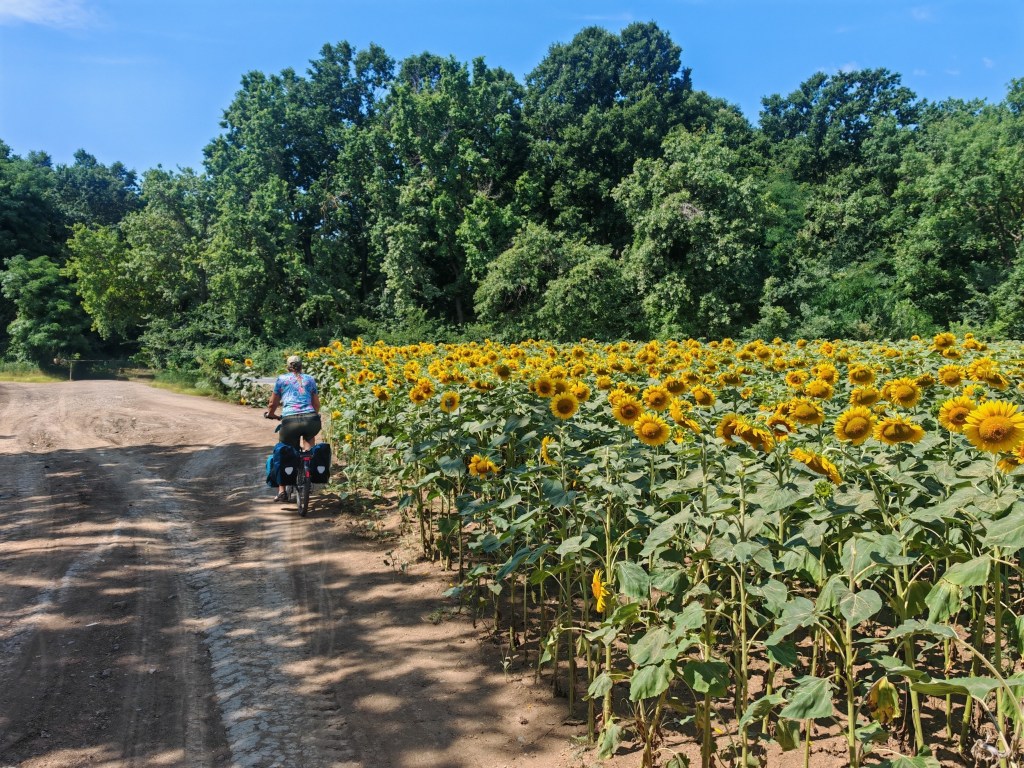
We are still in rural Balkans for the time being. The main crops here, watermelons and potatoes, are often harvested by hand. It is peak watermelon season, and they are sold out of the back of trucks minutes from where they’re grown.
We pass through a couple of towns and villages where what looks like tree bark on sticks is being sold. I find out that today is the Eve of Petrovdan, and this is birch or cherry bark, and it is used in an ancient folk tradition called “lilanje.” Children light the bark at dusk, and wave it around and chant a rhyme. It is a practice only occurring in this corner of Serbia (called Valjevo.) The tradition is thought to have begun in trying to keep wolves at bay from livestock, but the exact origins are lost to history. Once a pagan folk ritual, it has been absorbed into the Christian festival of St Peter’s Day.
We have to negotiate Belgrade. Try as we might to find some route round it, realistically we can’t avoid it. The approach road is narrow and busy, but we are expecting that. The pre-centre part is actually a pleasant series of bike paths by the Danube and through some parks. But then the nightmare beings. Bearing in mind that this is an official international bike route, the shittest part is on a multi lane main road through the centre, with buses stopping and pulling out everywhere, and under a teeth-clenching tunnel, and, for us and our direction of travel, up a hill at the end of it. I hate every second of it, and have used up so much energy trying to stay alive that I blow up a bit on the hill. It doesn’t help that it’s over 40 degrees yet again, and the constant adrenalin dump has worn me out.
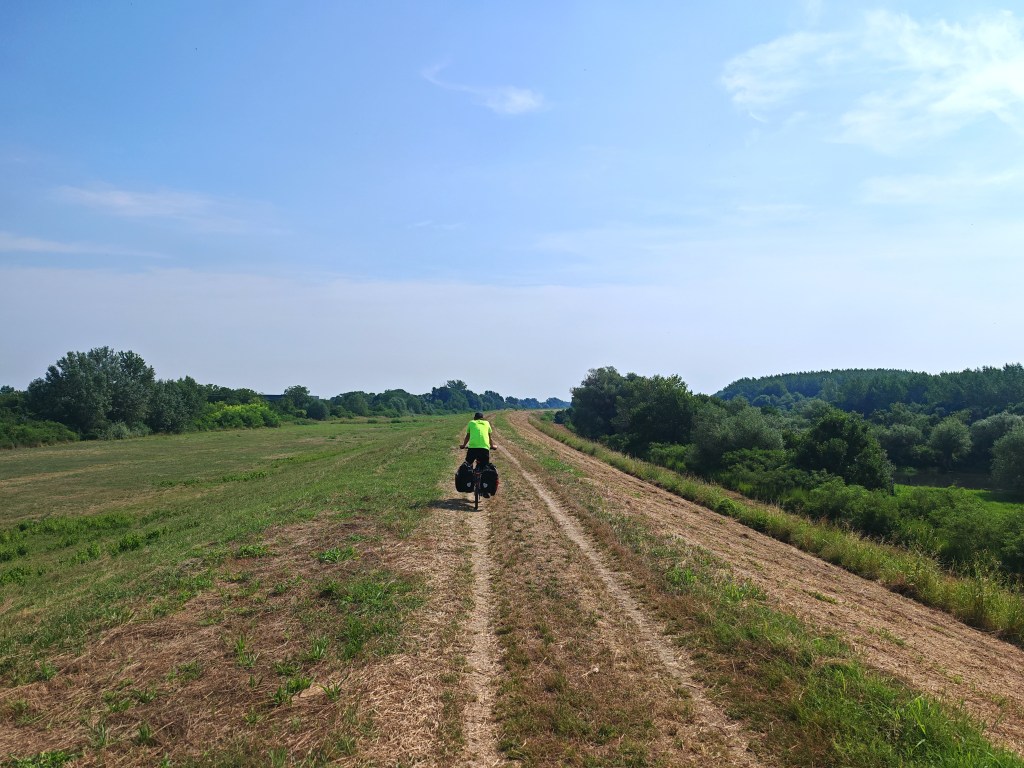
After getting my breath back, the large bridge we cross on the other side is fine, and then we turn off onto smaller roads. We follow the EuroVelo signs, which is a mistake. It takes us onto a grassy, gravelly path on a flood levee. Neither of us like this kind of cycling much, but the big problem is a huge headwind, full sun exposure and no shade. We get onto the road again as soon as we can, which is also not a good choice, since the roads here are narrow and dangerous. It feels like a marathon day, and it culminates in 2 kilometres of road works over a bridge, with only one lane open. There is no other route and no room for vehicles to overtake us, and we know the chances of us beating the lights the opposite way is almost zero. We put our heads down and blast across the bridge. I didn’t know I had the speed in me, but we manage a pace that doesn’t hold up the lorry behind us, and beats the lights. We both collapse at the other end. We’re only a few miles from our destination, but we have to take a lot of time to recover before we can get going again.
On the bright side, we’ve planned another day off. This time an apartment in Smederevo and another washing machine. Also another fortress, and this one is a stunner. I don’t want to leave the air conditioning, but Richard coaxes me into the sunlight with whispers of borek and coffee. The fortress was built in the 15th century, and part of it suffered huge damage in the Second World War, when it was used as an ammunitions depot by the Germans. The ammunition exploded, and as good as destroyed the entire city, killing thousands of people. Most of the fortress remarkably survived, and it is incredibly impressive.
We’re starting to see a lot of street cats. Presumably they are migrating to Turkey. It reminds me to get some cat food, but of course once I’ve bought a bag of cat biscuits, we don’t see any more. Such are cats.
The next few days we head south east. The going is slow as the heatwave continues – the heat index doesn’t drop below 42 degrees – and we have a torrid time. The roads are not safe for cycling. They are always incredibly narrow. There isn’t enough room for vehicles to pass each other and us as well, and since the roads are also busy, it’s quite stressful. It’s amazing how much it takes out of you to be fearful all the time. We’re unconsciously tensing our shoulders and tightly gripping the handlebars all the time. There are memorials every few minutes on some roads. There are so many that I wonder if it can really be that this many people have died on them. But then I see some more of the overtaking, some of the completely insane manoeuvres, and it’s not surprising. I keep my head down so I don’t see how many people are on their phones, because that is too terrifying to think about.
We do short days to try and manage the heat, but still by the afternoon it becomes a sufferfest. The best time I have in this part of Serbia is spending some time behind a farm vehicle, because I am out of the relentless headwind and go a bit faster.
Our southern goal in Serbia is the city of Nis. And finally, for the day we head there, the temperature drops a few degrees and the sky clouds over. There are some smaller roads we can take today, and out in the Serbian countryside on quieter roads in humane temperatures, we have a really good time. I thoroughly enjoy the climbing, and the views are lovely.
On one of the lovely roads, we meet a Serb-American who stops her car to say hello. She offers to put us in touch with a friend in Nis who is a keen cyclist and can help with anything we need. She is visiting from Alaska, of all places, to see family in Serbia. She has taken a small road to visit the graves of her grandparents who are buried nearby, before driving back to Belgrade for a long flight home.
Shortly after, we meet Goran, who waves us down from his house. He offers us food, drink and a place to stay. And gives us details of a good friend of his to contact, who has set off to ride across Central Asia, and is somewhere on the road ahead.
We stay a couple of nights in Nis. The first stop in the evening is a nearby small brewery bar. The beer is not good, but it’s still beer. Our day off is to visit the concentration camp (Crveni Krst) and the fort.
I was unaware, as I expect most people are, that Nazi Germany occupied this land (the Kingdom of Yugoslavia at that time.) The concentration camp here is one of very few which have been entirely preserved. This camp was largely used to house “hostages.” Jews were also interred here, and initially many were shot, but there were also transports to Mauthausen and Auschwitz. I learned that when transfers occurred, there are very few records existing of it, so the names and numbers of the holocaust victims from here is not fully known. The hostages were taken from the local population. They were used both for hard labour, and general cruelty, but also to quell unrest and resistance. For every German that was killed by the Yugoslav resistance, 100 hostages were shot. In 1942 the women and children in the camp were transferred to another one in Belgrade, where they were murdered inside gas vans. Notwithstanding those killed elsewhere, it’s estimated that 10,000 people from the camp were shot on the nearby Bubanj hill during the occupation, which was finally ended by the anti-facist Partisans.
From Nis we change course, and begin heading south west towards the border with Kosovo. There are only so many crossings to the tiny country. Kosovo is important spiritually and culturally to Serbs, and Serbia clings onto not recognising it as an independent nation. On the Serb side, most of the roads have either been deliberately destroyed, or made impassable.
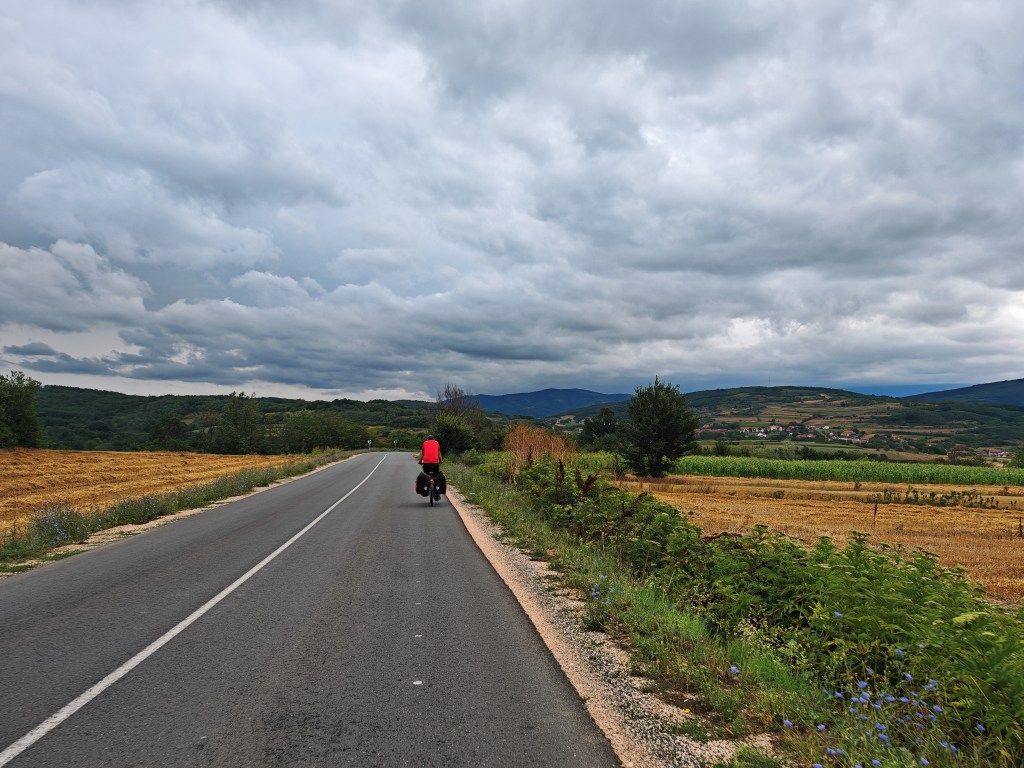
The cooler temperatures stay for our remaining time here, and the scenery is lovely. It remains a very busy stretch, but now the cars are mostly foreign, and almost all of them Germans heading off on their holidays, I assume in Greece. I suppose it’s not dissimilar to Brits driving to the south of France for their holiday. They are courteous on the road and generous with space.
We arrive at a homestay apartment for our final night, and are greeted warmly and given an armful of pears. We go for a coffee and are ignored, so we move next door and are treated like an inconvenience. Serbs can be almost competitive in their rudeness.
We have a huge day and a border to cross, so we’re out around 6am. We’re surprised that it’s rained heavily overnight. We don’t bother to check the weather anymore, because it’s just endless misery and warnings not to exercise in the heat. I have to have a coffee before we leave to become human. It takes ages to get served, but it saves us getting caught in an almighty downpour.
I stop at a bakery to get some borek for the journey, and the lady who serves me is comically rude, as usual. But they treat everyone the same way, it’s not directed at us, which is reassuring.
We start the day on some back roads, with the mist rising from the surrounding mountains. We join the main road, and the mass German migration. A nearby petrol station is going to be the only place to buy drinks on the long journey to the border, so we stop there to stock up. The attendant is delighted to see us, tells us we can use the loo in the back if we need to, and insists we sit and have our drinks in the garden. We really need to get on, but can’t refuse.
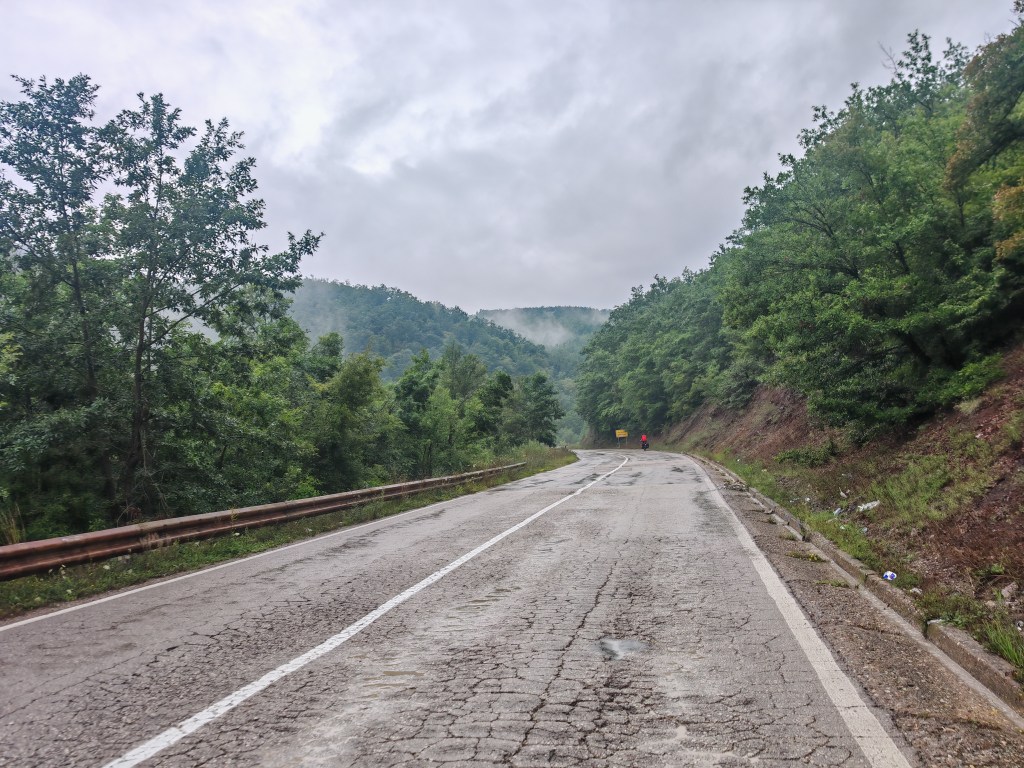
There’s a mid morning downpour, and we luckily find an abandoned monastery in the middle of nowhere for shelter. The road goes to shit about halfway to the border, and we are covered in mud and dodging potholes for a few miles. The only good thing is the cars have to take it as slowly as we do, which means we are not getting sprayed with water from them.
We don’t get a stamp at the border. Richard is worried and I’m annoyed, but the border guard is very emphatic.
The sun has burst through into an explosion of blistering heat, and the cool morning is forgotten. We have one of the worst headwinds I’ve ever experienced, and it’s hard work even going downhill from the border. I’m in a dark mood. On the Serbian side it was beautiful scenery and very few settlements. Kosovo, on the other hand, has built solidly right up to the border.
It’s a busy, manic, main road leading to Pristina. Suddenly there are loads of cars coming towards us off a roundabout, and beyond that, carnage. Traffic facing in all directions, and all at a standstill. We carry on, weaving through. About 95% of the time, whatever is stopping cars getting through can be negotiated by bikes, but after a couple of kilometres we come to the source of the chaos. A lorry has shed its load, and that is hundreds of crates of glass bottles, which are now carpeting the road. We can’t go round because it’s happened on a bridge. We approach the police and suggest we could carry our bikes and bags over. He’s sympathetic, but he sensibly says he can’t risk us cutting our feet and insists we have to take a detour.
The detour is of course up a sharp incline, before we join the main road again. It’s a busy dual carriageway. The drain covers are missing, and some of the road is flooded, so we have to be out in the middle lane, which doesn’t feel safe. It’s been a long and tiring day.
The final climb nearly kills me. I have hated Kosovo for the short few hours we’ve been here. The descent into the town is on backroads, on cobblestones and yet more roadworks. We’re staying at a small hotel down some old back alleys. We’re greeted warmly, which helps. After a shower and letting off steam I’m feeling better.
We go out into the charming cobbled streets and alleyways. We find a lovely place to eat, and the welcome is so sincere, the food so good and the beer so cold, that I quickly change my mind about the place.
Later, it’s Richard’s turn to be moody. We visit a traditional restaurant, and are seated next to a family whose child has been given an actual hammer to play with, and is busy hammering away at the wooden floor.
We go for a walk in the cool night air, to see the main square, the old stone mosque and clock tower. There are memorials in Pristina, but not as many as you might think. Kosovars perhaps want to look forward, and not rebuild their country based on the past.
We hope the traffic and scenery will get better once we clear Pristina, but that is not to be. The whole corridor is wall-to-wall industrial estates, car sales forecourts and shopping malls, and the traffic is relentless. I get a tow from another farm vehicle and speed by Richard. It helps me up a hill, but on the next one I don’t have the power to keep up.
We are in the midst of some of the worst drivers ever, and there is a lot of competition. They are aggressive and full of road rage. On the other hand, the switch from gruff rudeness in Serbia to smiling welcomes here, is stark.
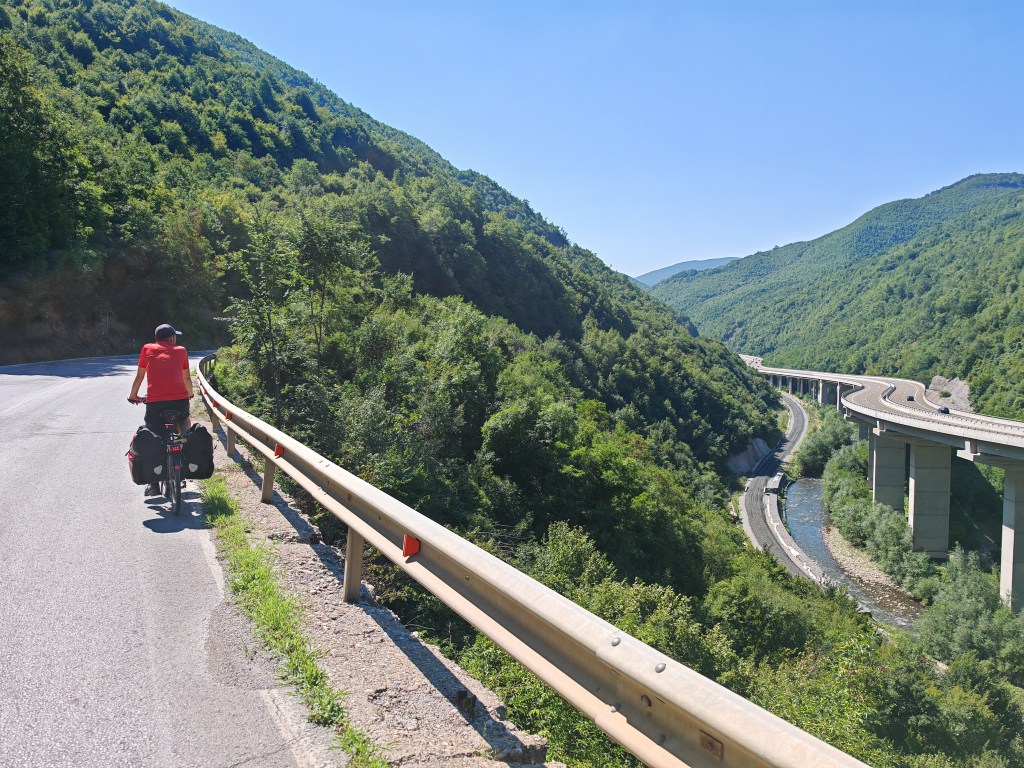
Kosovo is small, so even though we are slow, our time is here is short. The last day here is through very pretty scenery and on much quieter roads. There is a shiny new motorway running parallel which keeps our road so peaceful. It is also an amazing feat of engineering from the glimpses we see of it. We have a pleasant climb through the shade of trees, we’re met with lots of beeps and waves of encouragement, and then a satisfying descent to the border with North Macedonia. It’s been worth the effort to get here.
While we’re readying our passports, a taxi driver comes over for a chat. When we say we are British, he replies “Thank you.” And adds “We are like this” while crossing his fingers, indicating closeness. We’ve seen this sentiment before in Kosovo, and had similar in Albania. It is because of the key British and US intervention which forced NATO to act, and subsequently forced Serbia to withdraw from Kosovo during the 1990s war. Many Kosovars credit British and US politicians and armed forces for preventing an even greater massacre here. The first name “Tonibler” is not an uncommon one here. There is a street named after Robin Cook in Pristina. It’s nice to know we’re not always considered the bad guys, and to have a special connection with this country.
A playlist for the ride:


Leave a Reply