
Our route so far through Europe has naturally broken down into neat sections, such that we feel we’ve completed something at the end of each, and then can move on to the next part. Reaching Lake Konstanz completes the section across the Rhône-Alpes region of France, and then southern Switzerland. We celebrate with an ice cream overlooking the lake, which is much more pleasant to cycle round than Geneva was.
We’re also staying at a nice, bike-friendly campsite, with a laundry room, common room, and a communal fridge. We don’t feel like cooking in the heat, and now we are out of Switzerland we can eat with abandon without worrying about an overdraft. So it’s off to the supermarket to get a large haul of random foods that we fancy. All in all we’re feeling good.
It rains constantly for the next couple of days. The first day forces a needed rest, and the common room means we can keep dry. But because it’s wet, the room is crowded, and I wonder if we are the only quiet people on earth. I check with Richard, and apparently it would be rude to ask a kid to not play a game which involves throwing a handful of dice onto a hard surface every 5 seconds for over an hour.
I have the world’s worst poker face, so when I go into the common room in the morning and see that one couple have entirely taken over the tables with all their stuff, I stand there agape and then look very cross, as a lone German cyclist catches my eye and bursts into silent laughter. They reduce onto fewer and fewer tables as the tenters awaken and move into the room, and have the audacity to look annoyed about it.
I have cabin fever by now, so it’s a relief when the weather clears up and we can move on. We head north for Ulm, which is an unremarkable ride, but we want to join the Danube bike path there. It’s a part of much-trodden Germany that we haven’t seen before, and it will have us neatly flow down into Salzburg, where we want to get started on Austria.
Ulm is a great chance to visit some traditional taverns and tuck into my favourite type of food and beer. In the evening I try some Swabian dumplings and drift off into heaven. I’m not sorry that it rains more here; it’s a good excuse to stay two nights and see some of the city. I’d seen another beer house whose food I was anxious to try, and there is also a museum of bread. I am probably an outlier, but Germany easily outstrips any other European country for me when it comes to food. All my dreams come true at lunch, with bread dumpling topped with fried breadcrumbs, roast pork, and beer gravy, all washed down with weissbier.
The Danube cycle path from here involves almost no Danube. Instead, it’s a dull trudge through farmland on mostly gravel paths. We see the same family at camp for a few days in a row. They arrive each day at least three hours after us, and five on the last day. We cannot figure out what on earth they do for all that time, when we ourselves are not particularly fast.

The middle section of the route to Regensburg has a couple of very pretty towns, and we bookmark some of them to visit one day in a non-cycling capacity. We spend a lovely afternoon wandering around Neuburg an der Donau, with its impressive castle and Renaissance palace. We’re camping on the grounds of the boat club, and they also rent out small cabins with bunks. I get a glimpse into one, and I’m glad of the tent.
We have lost our fellow cyclists by this point, but we have gained some earwigs. We noticed a lot of them in the tent one day back in Switzerland, and they must have burrowed their way into our various bags, as each day a new one pops out of some corner of our stuff. Richard is beside himself; he hates any kind of bug or insect.
The heat is turning up again; another heatwave wafts its way across the continent, engulfing me in sweat and misery. The endless crappy gravel surface darkens my mood further, and as we near Regensburg Richard becomes convinced something is wrong with his bike. There’s a definite squeaking noise, but we can’t find the source of it, and it sounds external so we just assume it’s nothing serious.
The scenery and the path get much, much better around Regensburg. We’ve been to to the medieval city and Gothic cathedral before, so we don’t stop. There’s a brief respite from the heat with an evening of rain. We duck into a supermarket to get food, and there’s a self-service food bar where I load a box for two with a kilo of food for just me.

Richard identifies the sound from his bike as a loose spoke, which is worrying. We’re on the small part of the Danube in Germany that we’ve cycled before, and we know there’s a good bike shop in the next town. The mechanic tightens the spoke, checks the others and the wheel alignment, and we’re good to go again. He won’t accept any payment.
The heat has again become insane, and we’re desperate for shade and out on our feet. It’s a Sunday, so nothing is open and we’ve had to make do with progressively hot water that we’ve carried with us all day. We screech to a halt beside a church with a fountain, where we can indulge in cold, fresh water, and perch at the edge of a stone memorial. As we shuffle round to the side, I can see now that it’s a war memorial. The names of German soldiers killed in WW1 on one side, and those killed in WW2 on the rear side. I’ve never seen a memorial in Germany commemorating their dead, but hadn’t thought on the absence until seeing this.
We arrive at our final German campsite, intending to make it to Austria the next day. We’re given a choice of pitch, but they are all stoney and only one has any shade at all. We spend the rest of the afternoon and early evening moving round with the shadows. A German couple invite us over to sit with them under the awning of their caravan. They make us coffee, and offer us cold drinks. The man speaks very basic English, and I speak ultra basic German. It’s amazing how much we can communicate though. He tells a story about going on holiday and forgetting to pack pants, I don’t have a similar story to share, but I offer to swap our bikes for their motorhome.
The tent is as hot as a greenhouse until about 11pm, and when we do turn in I’m just lying in a pool of sweat and unable to sleep. It’s dark enough that I can escape outside and sit there in my unforgotten pants and a t-shirt, until I’m tired enough to sleep.
I’m bitten by what was probably a horsefly. One knee and one hand swells up overnight like someone’s taken a hammer to them, and the knee is painful to pedal on. But it’s good to have something other than the heat to complain about.
I’m overjoyed to be able to stop at a Lidl in the morning and pick up bread rolls myself. We haven’t seen one for ages, and other supermarkets don’t often sell bread, because there is usually a bakery attached. That means I have to endure the humiliation of trying to ask for things such as Sonnenblumenbrötchen, when no one but me sees the funny side of me trying to pronounce it.
We have an emergency pow wow about what to do. We’re just outside the Austrian border and it’s too hot to exist even before 10am. We can’t camp in this heat, which is going to last more than another week. We planned on crossing Austria and then Slovenia, but it’s too expensive in both of those to stay in hotels or guesthouses the whole way. We decide we have to pick one and skip one. We’ve never been to Slovenia, so that gets the nod.
Fortunately there’s a station not too far away, where we can get a train to Salzburg and then change to get us almost to Slovenia. We have a couple of hours to kill, so sit at a cafe in a pleasant town and watch the world go by. There are some tour groups on guided tours walking about, which is puzzling. As nice as the place is, it doesn’t seem that remarkable. A quick search and we find out that this was the birthplace of Hitler.
The train is so easy and cheap to do, that I’m glad we made the decision to go to Slovenia, because it means Austria should be easy to get back to if we want to complete this section another time.
The heat is sickening, so even though we’ll cycle across Slovenia, the route we take is going to be dictated by it. We opt to follow the Sava river, trying to keep things not too strenuous.
The first place we stay is above a very traditional tavern, where Richard, in 40 degree heat, orders a beef goulash.
The route is a good choice. It’s pretty enough, and the path by the river has enough shade to stop us burning. The road to the north of Ljubljana is a bit worrisome, but once we’ve cleared that it’s quiet roads for most of the way.

We stop to rest on a bench outside a church, and a man using walking sticks slowly makes his way over to us. He says he can’t really speak English, but points to the bikes and tells us he once travelled to many countries this way. “But that is no more” he says in a whisper, gesturing to his walking sticks.
I comment to Richard that the friendliness here is noticeably Balkan, and we get into a debate about whether the country is in that region or not. I’m surprised to find that actually Slovenia is not commonly considered the Balkans, and that it might be somewhat insulting to suggest that it is. I think that perhaps because the Yugoslav wars were one of the biggest news events of my childhood, I associate all those now independent countries together.
The contested distinction reminds me of philosopher Slavoj Žižek’s words on the subject: “this is how it is in the Balkans, but Slovenia is not part of the Balkans; it is part of Central Europe; the Balkans begin in Croatia or in Bosnia; we Slovenes are the last bulwark of European civilisation against the Balkan madness.” If you ask, “Where do the Balkans begin?” you will always be told that they begin down there, towards the south-east. For Serbs, they begin in Kosovo or in Bosnia where Serbia is trying to defend civilised Christian Europe against the encroachments of this “Other”. For the Croats, the Balkans begin in Orthodox, despotic and Byzantine Serbia, against which Croatia safeguards Western democratic values. For many Italians and Austrians, they begin in Slovenia, the Western outpost of the Slavic hordes.”
Our last couple of days in Slovenia are all about trains. We visit the Litija railway station, to take some pictures of an old engine. A young man approaches us to ask where we’re from. I suppose stopping to take pictures of a train gives us away. He has just turned 18, is heading for Zagreb and is anxious, because it will be his first night “without a roof.” His train arrives so he runs off, and I don’t know if he’s voluntarily travelling, or if he’s been made homeless, and don’t get the chance to ask.
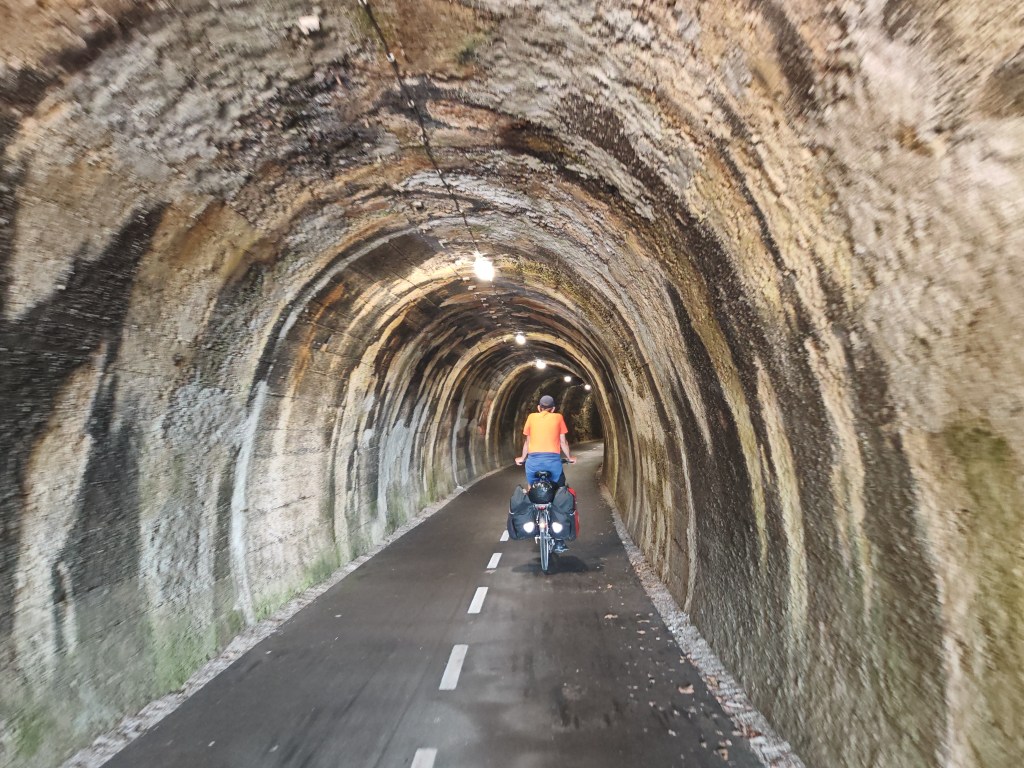
Next up is a bike path through an old railway tunnel, near Brestanica. It’s only half a kilometre long, but it’s so wonderful being underground surrounded by the cooling stone, that we go back and forth several times.
The following day we cross into Croatia, which is in the actual Balkans. Or maybe not, depending on who you ask.
A playlist for the ride:


Leave a Reply