
Border at Poipet
It’s a really busy border, and if you catch it at the wrong time (say when there’s a coachload of schoolchildren visiting from the US) it can be a long wait. Both passport checkpoints on each side of the border are in a room upstairs, so you will have to leave your bike behind for those bits. When you’re done you’ll be directed to go through the opposite door to the one you came in, but that will leave you and your bike on different sides of the border, so just explain that and go back the way you came. You’ll then have to wheel the bike through the barrier and show that you have already been to get the proper stamps.
Route 6
The roads around Siem Reap are well surfaced and in great shape. It’s pretty busy though. Otherwise this is not a great road. It’s old and a bit bumpy, often with little shoulder. It’s quite busy with trucks, and they scream along. We had an almighty headwind, so our view is coloured by that.
Route 66/67
The roads are much quieter, but they are old and getting very bumpy. We took a couple of days off round here and did some off road trails. There is a landmine museum, butterfly sanctuary, Banteay Srei Temple, Kbal Spean and Angkor Conservation Centre up on this route, so it’s well worth doing if you fancy getting slightly off the beaten track and off the main road in Cambodia.
Unnamed Road: Stueng Saen to Kampong Laeang/Kampong Chhnang (cutting out Phnom Penh)
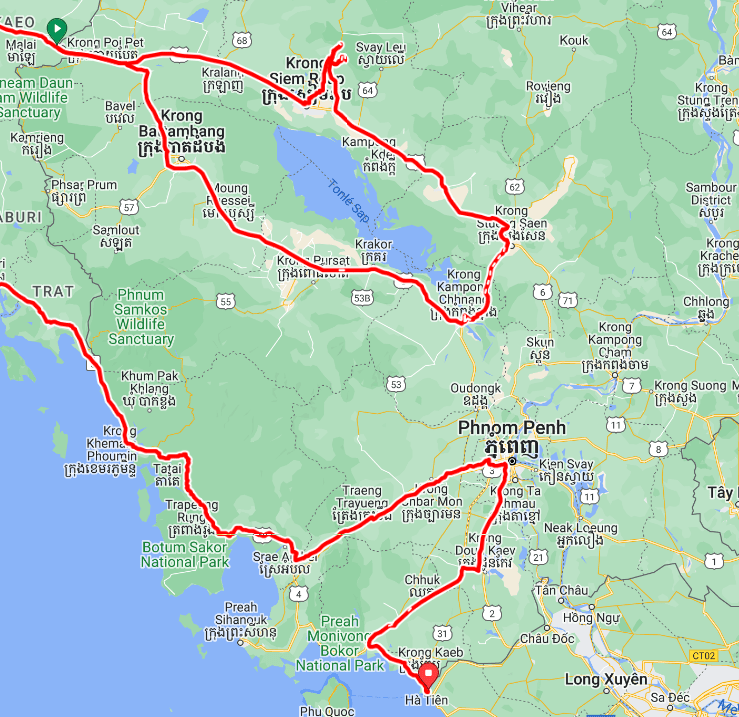
We did a circuit round the Tonlé Sap lake in Cambodia (Route 6 on the northern side, Route 5 on the southern,) but didn’t want to cycle near the capital, so used this route with a ferry across the river from Kampong Laeang/Kampong Chhnang to cut out the Phnom Penh area. It’s paved for about 10km either end, and the rest is the hard-packed orange dirt that you’ll become well acquainted with in this part of the world. The surface itself was not too bad to ride on, but lots of trucks go past at high speeds and the dust they kick up is unreal. It makes visibility zero, so can be slow going. A headwind would be horrific here. Rain would be worse. The ferry is a big rolo affair. There’s a toilet, although that might depend on your definition of the word. It was a shorter journey than billed – only 20 minutes. However, it will wait until it is full to bursting so almost certainly won’t leave on time, so don’t make plans. As you approach the ferry ramps turn to your left and you should see the small ticket booth. There were also ferries to Phnom Penh from here, which wouldn’t be a terrible idea if you wanted to avoid cycling into the capital but still want to go there.
Route 5
This is quite newly surfaced (early 2023) and is much, much better than route 6. It’s also not as busy as the northern route, has wider lanes and a wider shoulder.
Border at Chham Yeam (Khlong Yai on the Thai Side)
This is a very quiet border. We were made to wait a nerve-wracking amount of time on the Cambodian side while our e-visas were checked out. Probably the border guard was just bored and wanted to string it out though.
Route 48
The border town proper is Koh Kong, a flat 10km ride from the Thai border with a very nice modern bridge leading to it. There are plenty of banks and ATMs here, mostly on the roundabout as you enter the town. We found that we could only withdraw US dollars, but the bank we used were happy to change some to riel for us. There are places to stay in the town. Don’t be fooled by the nice road here, it turns to dirt a few kilometres east on Route 48. The surface is really rough. There is a very steep 300 metre ascent about 20km outside of Koh Long just after the river crossing, which is hellish given the surface. There is very little traffic, and it’s quite remote, so take plenty of water. There are places to stay in Tatai (at the start of the climb,) at Trapeang Rung, Botum Sakor and Sre Ambel, so they are nicely spaced for a variety of distances.
Route 4
We turned off onto Route 4 at the junction just past Sre Ambel. The road is paved and well surfaced from this point. It gets busier the closer you get to Phnom Penh, obviously, but it’s never too hectic until the final part. This particular approach to PP floods badly in the wet season on the outskirts of the city. We were there at the tail end of the season and it was barely passable.
Route 2 and 3
We visited the Choeung Ek Genocidal Centre (better known as “The Killing Fields”) on the way out of Phnom Penh, and stayed at the only guesthouse in that village, which was basic but fine. Then we hit Route 2 going south, which was busy but well paved and wide-shouldered. We then took the connecting road 22, heading west from Doun Kaev, to get across to Route 3 and followed that to Kampot. From that turnoff the road was much quieter and more pleasant, and continued like that all the way until a few kilometres before Kampot, where is became busier again. We stayed in or passed guesthouses in Angk Ta Saom and on the 22 road in and around Chhuk.
Route 33 and the 1332 to Prek Chak/Ha Tien Border (Vietnam)
After you clear Kampot, Route 33 becomes a dust and pothole nightmare until the turnoff to the border. It’s not a long stretch though and the 1332 is a nicely paved and quiet road through small friendly villages. It’s a nice send-off from Cambodia.
The border at Prek Chak is quiet and efficient.
Angkor Wat
Book tickets via the Angkor Enterprise site. You need a digital passport type photo for your ticket. The site is annoying to use and uploading your picture is a complete pain, but the alternative is visiting the physical ticket office which is neither in the centre of Siem Reap or on the way to Angkor Wat, and it involves long queues.
The whole complex here is ideal to get round on a bike, and we always found something to lock them to when we went into the temples. There is no single entrance to the archaeological park, which is spread over many acres, rather there are various roads going through and around it. We were pulled over at several points while cycling round and asked to show our tickets, and also at the entrance to all of the most popular temples. So if you were thinking of not paying and sneaking in it’s really not possible, and also: Don’t be a dick.
There’s no getting round the fact that it’s expensive when compared to the amazing temples and ruins in Thailand. But it’s probably the one site in Cambodia you’ve come to see. You can buy day or multi day passes. The multi day ones (3 or 5 days) don’t have to be used on consecutive days, but they do have a time limit by which you have to use them. They cover not only AW, but various temples and sites in other parts of Cambodia as well. If you do plan on visiting Banteay Srei temple and Kbal Spean waterfall and tablets a bit to the north, those are included in the Angkor pass. Note though that the 1000 Lingus Temple is not included; if you want to visit that you need to pay the entrance fee for the privately owned Kulen National Park, though that also includes a series of waterfalls which are inside the park.
Money: The currency in Cambodia is the riel. Many places also accept US dollars, but this is being phased out, particularly with lower denomination notes. Cambodians are very, very fussy about dollar notes they’ll accept – the slightest tear or mark can mean it will be refused. Keep an eye on the notes you are given, as getting a high value one that no one will accept can be an issue, and those need to be pristine. You can withdraw US dollars at almost all cash machines, in fact sometimes that is the only currency you can withdraw. Some ATMs will only dispense $50 or $100 notes so you do need to plan your spending a bit. You will often be given change in riel whatever currency you use. The riel is worthless outside of Cambodia and you won’t be able to change it after you leave, so be careful about how much you have left as it comes time to leave. Most places will take a combination of riel and dollars though, which does help.
Blog posts for Cambodia:
 Ride & Seek