
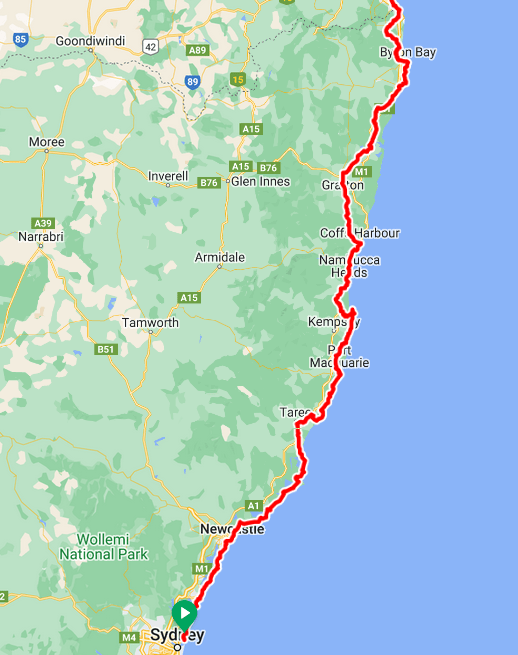
We took the slow Manly ferry from Sydney to get out of the city. Just wheel the bikes on and put them at the back of the boat where there are straps to hook them to. The view of the Opera House and Harbour Bridge are amazing.
From Manly we then hugged the coast as much as possible until Forster. This was one of the best parts of our entire trip so far. It’s wonderful cycling, with medium toughness. Where it’s hilly the inclines are often sharp. We took some tracks through National Parks which were often gravel and corrugated. They would be a nightmare in the wet.
We found Myall Lakes and Arakoon National parks to be particularly great. You will see wild kangaroos along this stretch, often at campsites.
At Forster the lack of roads forced us onto the A1/M1 (known as the Pacific Highway) for some sections. Where it’s labelled M1 then it’s a motorway. Australia’s low population density means that there just aren’t that many roads, so this is allowable. There is usually a very wide shoulder. We found the highway/motorway safe to ride on, but just not very scenic. The coastline all the way up to Byron Bay is really spectacular, so it is worth taking detours off the PH to the coast.
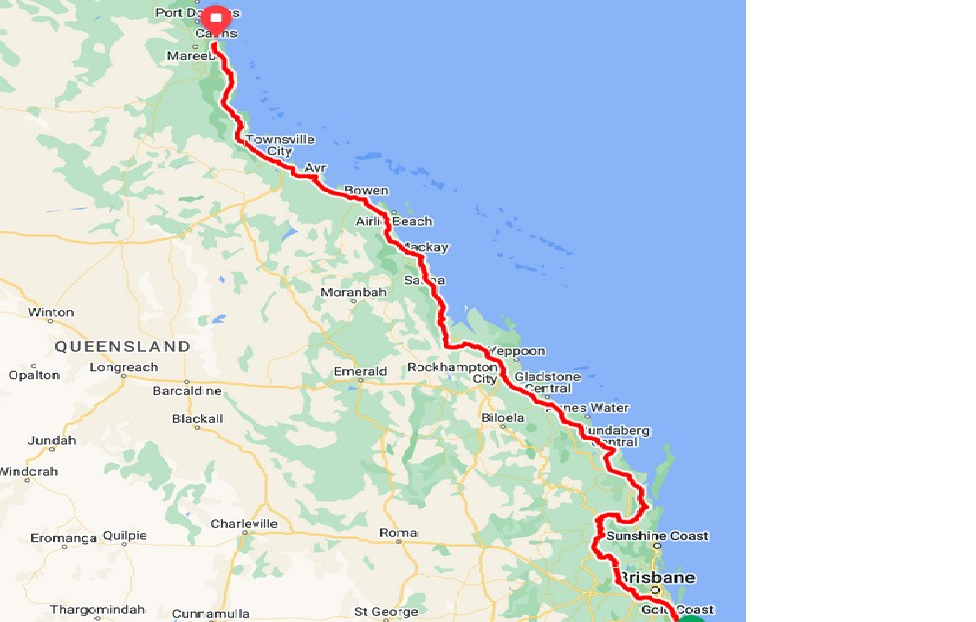
On reaching Queensland, there are cycle paths through much of the Gold Coast and south Brisbane section. The ones around GC are along the coast but are shared use, and it’s a popular place so it is slow going. The cycle paths around south Brisbane were really good and well signposted, but we didn’t want to do city cycling, so we diverted off to Ipswich and picked up the Brisbane Valley Rail Trail from near there. I’d highly recommend doing this. Some parts are a bit off road, but quite tame. The trail takes you to Yarraman (we stupidly left it at Blackbutt trying to cut a corner off to Nanango. It meant wading through rivers and walking a lot of the way. Don’t do this.) From Yarraman it’s a short hop to pick up another rail trail starting at Kingaroy and going to Kilkivan. The second half of this one is really off road. Large sections of rocks and gravel and then fields. From there we went east to Gympie and then east/north through the Toolara and Tuan State Forests. Really beautiful scenery in this area, but very narrow busy roads in parts.
From Maryborough, apart from side loops to Bundaberg and Gladstone, there’s very little choice but to ride the A1 all the way to Innisfail. This part of the A1 is called the Bruce Highway, and it’s pretty notorious as a long, monotonous and dangerous road. In general, the Bruce is single lane, the surface is compressed chippings and it is narrow. There are sections where the surface is better (around Rockhampton for example) and where the shoulder is wider, but for the most part it is not a pleasant ride.
There are side shoots off the Bruce, but if you want to take one you mostly have to take the same road back – there aren’t many road which loop off and rejoin the Bruce further on. People recommended Airlie Beach to us as the best of these one road in, one road out detours on the southern end. This is also the place where you’d visit the Whitsundays islands from. We didn’t do it because it was prime tourist season and there weren’t any campsites available. Further up, Mission Beach offers boat and snorkelling to the Great Barrier Reef, and is much less busy than Cairns or Port Douglas. Plus this is one of the only detours where you can leave the A1 and rejoin it further up without having to backtrack. We stayed on the Bruce all the way to Cairns, but there’s the option of visiting the Atherton Tablelands if you break off it from Gordonvale.
The prevailing wind on the Queensland coast is south to north, and it is quite pronounced. It gets more severe the further north you go.
Accommodation (everything in AUS$)
Is expensive!
Rural pub hotels sometimes have cheap rooms with shared bathrooms and are easily the best value if you need a roof over your head. Pubs are often called “Hotels” though regardless of whether they have accommodation, so best to check beforehand if you are relying on one. Sometimes the ones with accommodation are referred to as “Hotel Motels.” So that clears that up.
Roadside motels can be over $150 or under $100 depending on location and competition. They usually have cavernous rooms, a kettle and microwave, and often even a pool that no one uses.
Holiday/Tourist Parks are what paid campsites are usually referred to as. They cost on average $25-30 for a site in NSW, and $20-25 as you start to get into central Queensland heading north. The prime tourist location ones can cost as much as $60 (!!) in a place like Byron Bay, and in really busy times (school holidays) often have a minimum of 2 or 3 night’s stay required. They will always have toilet/shower blocks with hot water, laundry facilities (usually coin operated) and BBQs. Almost all have a “camp kitchen” which is at minimum a covered area with seating, kettle, toaster, fridge, microwave, running water, and sometimes a stovetop and oven (might be a portable one.) They almost always have washing up liquid and cloths, so you don’t need to buy those. Some of them are indoors, some even have pizza ovens, slow cookers and pots and pans for you to use. Price is not necessarily an indication of those facilities, it’s more about location.
If you stay at these parks, check beforehand that they have grassed sites or areas for tents. Very few people tent camp – even when referring to tent camping at tourist parks most people mean a tent add-on to their caravan or a pop-up structure as part of their camping trailer. That means that some pitches are gravel, or a concrete slab set in grass. If you have a free-standing tent that’s fine (although uncomfortable,) but if like us you have a tunnel tent that has to be pegged out this can be an issue.
National Park campgrounds in NSW: Prices vary depending on facilities and location. Expect around $12 for drop toilets and not much else and $45 for beach side camping with hot showers and a camp kitchen. All of them will at minimum have drop toilets. Most will at least have a cold outdoor shower (the kind you have by the beach.) Most will have a covered picnic area and a gas hotplate BBQ (they’re usually free to use.) The next step up will have shower blocks with hot water, and some might have a camp kitchen (indoor area with seating and stovetop/microwave/kettle/toaster available to use) and machine laundry.
They must be booked and paid for in advance. That can be done here:
https://www.nationalparks.nsw.gov.au/camping-and-accommodation
The website also has a handy map search for campsites.
Free Camps. Usually either provided by the local council or a Rotary/Lions Club. Just to reiterate the above, no one really tent camps, so any mention of a camping spot often just means a place to park an RV overnight. The Lions/Rotary free camps are usually in a town and often hard-standing. The council ones are more often at rest stops by the side of the road and usually have grassed areas. Many specify that campers have to be self-contained, which excludes tents, or they explicitly state that no tents are allowed. It’s hard to say whether it gets regularly enforced though. They can get very busy, so it’s not a good idea to take up space that an RV or caravan could use. If you tuck yourself somewhere that an RV couldn’t park anyway you’ll probably get solidarity from other campers. The public camps are always next to public toilets, and quite often have covered picnic tables and maybe hotplate BBQs (some are coin operated) so you do get some facilities. A couple we stayed at had showers too.
Showgrounds and Sport Clubs. Many showgrounds and some rugby clubs pull in extra cash by offering camping on their grounds. For insurance purposes some don’t accept tents, but that is rare. They usually charge in the $10-15 range and offer toilets and hot showers, sometimes a basic kitchen. Most rural towns and villages will have a showground. It’s a good way to stay in a country town cheaply. Some of the small village showgrounds operate on an honesty system, where they’ll place envelopes in the amenities block for you to put cash in if there’s no one around.
There isn’t really an equivalent of showgrounds in the UK, but I guess the closest would be a village green or recreation area where local fetes and events take place. Showgrounds have a more formal setup than that though. The setup is not dissimilar to racecourses in the UK offering camping, since they have the facilities and space.
Pub Camping. Some pubs, particularly rural ones, offer camping on their grounds. Sometimes there’s a nominal $5-10 charge, but usually they ask that you buy a beer or a meal in their pub, but otherwise don’t charge (they might sell you a redeemable voucher to make sure you keep your end of the deal.) We were allowed to stay for free a couple of times. You get to use their toilets, and many also have showers. And you get to visit pubs that are sometimes frozen back in time; some of them are corkers.
Connectivity
Wifi coverage and phone service are surprisingly terrible. Both the large supermarkets (Coles & Woolworths) usually have reliable free wifi though, so hop there if you need it. Phone coverage can be very patchy and varies regionally, so choose your SIM provider carefully. Vodafone was brilliant in NSW then it was almost total blackout, no service at all until the far north of Queensland, and then it was patchy. Telstra easily has the best overall coverage, but still not comprehensive. We also heard good things about their budget brother Belong. It’s probably best to get a couple of pre-paid SIMs from different providers rather than a contract, so you can chop and change when you need to without wasting data you’ve paid for.
Food: Is REALLY expensive!
I’d estimate supermarket prices to be 20% more than the UK across the board, but a lot more for some things.
The main supermarkets are Woolworths and Coles. They are much of a muchness. IGA is nationally owned but run locally as franchises so they can vary quite a bit. They can have some amazing deals, though are more expensive overall. But they often have some cracking boxed hot food (usually butter chicken or lasagne, but we nabbed full roast dinners once,) and if you visit at the end of the day these can be marked down quite a bit. Drakes has a smaller presence, and similar prices to IGA. Aldi and Lidl have a presence in retail park type outlets in some major towns, but we didn’t see many of them.
The layout of supermarkets here doesn’t make sense to me, and I wander round them in bafflement. It’s like walking into your local supermarket to find that everything has been moved around every single time you go in. WHY AREN’T ALL THE FRIDGE THINGS TOGETHER AUSTRALIA. And why are eggs sometimes refrigerated and sometimes not? And then there is the confusion of Manchester.
Hotplate BBQs are everywhere, especially in NSW – public parks, rest stops, campsites. The fact that they are hotplates rather than grills means you’re really just frying on them. You should clean them after use for the next person. We found that using greaseproof paper (or foil) on the surface to cook food on, rather than putting food directly on them, to be a revelation. Saves an enormous amount of hassle cleaning them up, and means you can fry eggs and veggies and things which might otherwise make too much mess. We only used our stove a couple of times the whole 3 months we were in Aus, thanks to the cooking facilities available.
Eating out is not as expensive as you might expect when compared to the cost of food in shops. Australia has the highest minimum wage in the world, and very strong labour laws in general, so I really don’t know why this is. A burger, schnitzel or chicken parmi in a decent pub/tavern will set you back about $22 (£12.) Portions are large. A hot pie from a bakehouse is $6-7. Australians don’t really do condiments. You won’t find red sauce or mustard on your table and you won’t be offered them. The exception is pies, where you will be asked if you want sauce.
Tipping is not normal at all, so if you’re from a country with a tipping “culture” don’t bring that with you.
Cash & Cards: Australia is largely cashless, but you still might need some if you visit roadside coffee stalls and some showgrounds for camping. MasterCard doesn’t always work when using chip and pin. And if ordering or booking something online (flights for example) foreign issued MasterCards won’t usually work on Australian sites.
Bendigo bank had the cheapest cash withdrawals, in a country where charges for using ATMs with foreign cards are very high.
Washing: If the weather’s bad or you otherwise don’t want to do your own washing, then launderettes are ubiquitous, and most campsites, some showgrounds and some cheap motels also have machines you can use (for a fee.) It costs between $4-6 for a load and the same for the dryer. So not cheap.
 Ride & Seek