
吃得苦中苦,方为人上人。 Enduring deepening pain is how man ascends
The owner of the inn is a former history teacher and a marathon runner, proudly displaying his medal and trophy collection in the family room, which doubles as the entrance room to the homestay. It is freezing in Dali, but our room has thick duvets and an electric blanket making it cosy to sleep in.
There’s a three-wheeled tuk tuk van parked near the inn. I have always wanted a tuk tuk, and joke about buying it and getting to Shangri La that way.
The short ride here means we have most of the afternoon to wander round the streets. Unlike the fake ancient town in Lufeng, Dali is actually ancient and also really busy, though it should be the quietest time of year – deep in winter and a few weeks before China’s major holiday. I’ve seen complaints that this place caters a bit too much to (Chinese) tourists. There are lots of shops renting out traditional dress and some contrived Instagram spots for photos wearing it, as well as stalls selling tat and lots of bars and cafes. With the first two things I can see that being very distasteful to the ethnic minority who predominate here. As for the rest, in a country that can be unapproachable and inaccessible, we are grateful to spend a couple of days in this environment.
We are able to try some street food, and there are lots of places giving out free samples. Richard hates mushrooms, and dishes here are never for only one person, so I snaffle those as we walk around.
Back at the homestay, the family are taking tea and invite us to join them. It’s a fascinating ritual involving several pots, and a careful selection of leaves. In addition to being a marathon runner, the inn owner is also a mountaineer, and shows us videos of precarious hikes up Diancang Mountain in knee-deep snow and thick fog. He explains that he also does search and rescue, and every year he and his group rescue lost hikers, and recover bodies from the mountain. It is fiercely windy here, and he says it can make a mountain ascent in this area very dangerous. Last year he says they recovered fifteen bodies.
Richard and I make a pact before we go out in the evening that the first place that calls us in is where we’ll eat. We’ve become attuned to when people don’t want us here. Some quite bluntly walk off when we approach, most turn their backs or just studiously look at their phone until we have passed. We don’t want to make anyone’s job difficult, and it’s easier for us also if a place is hospitable. One lady enthusiastically waves us over, and runs in to get a menu for us to look at. She’s patient as we sit and translate, and joins in recommending things and making sure we are okay with spicy food. The old man cooking and serving the food and the tea is also friendly and welcoming, and the food is great, as it always is here. All in all it’s been a nice start to a couple of day’s rest.
Our host takes us out to breakfast the following morning to a small noodle house, and then serves tea back at the inn. This is a time-honoured and reverent process. He shows us some of the tea cups he has collected, including one from the Ming and one from the Song dynasty. There are a huge array of packs and cakes of tea on the shelves. He carefully selects one and tells us this is a pu’erh tea that’s been aged for 27 years. We get to see the entire ritual from the beginning, which is fascinating and a huge privilege.
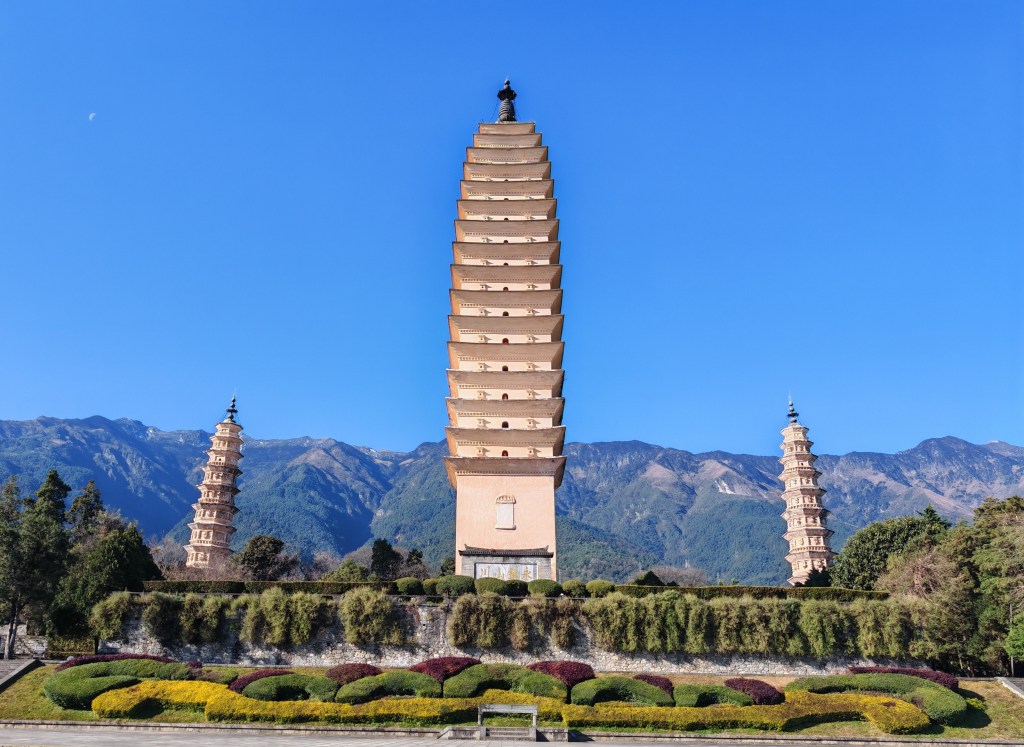
Warmed and content, we head to the Three Pagodas and Chongsheng temple outside of the city to spend a relaxing day sightseeing.
In the evening we visit a craft beer house we stumbled on the day before, where George has been brewing for 12 years. On the way back we are collared by our hosts, and after trying to politely turn down tea, the owner shouts “No! BEER!” And I know I am doomed.
The owner’s nephew is staying and helping out while he waits to hear if he’s been successful getting on a post-graduate program at a far-off university. He speaks impeccable English, which helps the conversation between all of us along, and we spend a really pleasant evening with them. He is particularly curious about life in the UK and how it differs from China. It does in lots of ways, but we also have much in common, and our conversation reminds me of the great lesson of travelling: That we have more that unites us than separates us. The nephew reveres his uncle, who gave up a comfortable teaching job in Nanjing because he wanted to come here and climb mountains, and made a life for himself on his own terms. There’s tea (this time from the mountains of Lincang) intermingled with the beer, which helps keep our heads clear. Then the baijiu comes out.
On the morning we leave we intend to get an early start, but it’s freezing and our host is waiting to take us to breakfast again. The three wheeled tuk tuk turns out to be his, and we ride in the back of it through the narrow streets to another traditional noodle house. I think he’s bemused at how excited I am about this, and perplexed that I want so many photos of us in this thing.
The noodle shop we’re taken to is one I’d had my eye on, but seemed intimidating. The noodles we try have a mix of traditional dried and fresh beef, and a rich and spicy broth served in big metal bowls. I admit that noodles for breakfast would not be my first choice, but this one is really great.
The day from Dali starts out beautiful. It’s getting very cold overnight, and the mornings are below freezing, but that means a blanket of frost covering the fields which adds another layer of charm to the scenery. It is flat for most of the first day, which is the only experience we have of that in China. Towards the end, there’s a climb through a canyon which is scenic, but leaves us aching.
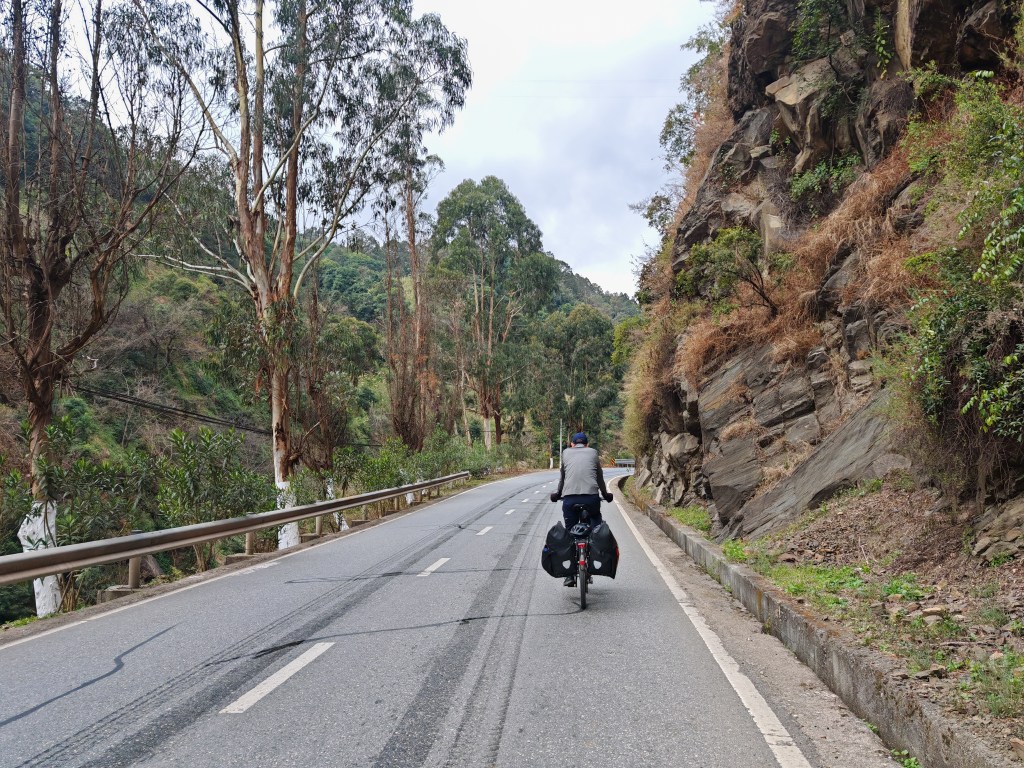
After that, the mountains continue relentlessly, and get monumental as we enter an autonomous prefecture of Tibet, and the area of Shangri-La. At the end of each day we are out on our feet with head to toe exhaustion. I’ve said to myself “I’m never doing this shit again” countless times in the last few days.
There is actually no such place as Shangri-La, or rather, the place from James Hilton’s Lost Horizon is not real. The Chinese named a region and a city after the fictional place as a way to boost tourism.
As we approach 9,000 feet, we both have difficulty in the thinner air. The day we climb highest is on a quite narrow road, and there’s not much space for us when the lorries pass. We are pedalling faster than we’d like to get round the blind corners, and some parts are very steep, so it takes its toll. At one point I have to stop and rest for a while because I start to see stars. And after that it goes on and on and we are both wrung out. I have the bike computer, with the data for what is coming up. We stop to sit on a wall, out of breath and wheezing a bit, and I don’t want to tell Richard we are not even halfway up yet, but he asks. We watch a lorry up the road ahead having trouble on the hairpin bends, and then we see where the road leads and how steep it is, and I want to cry.
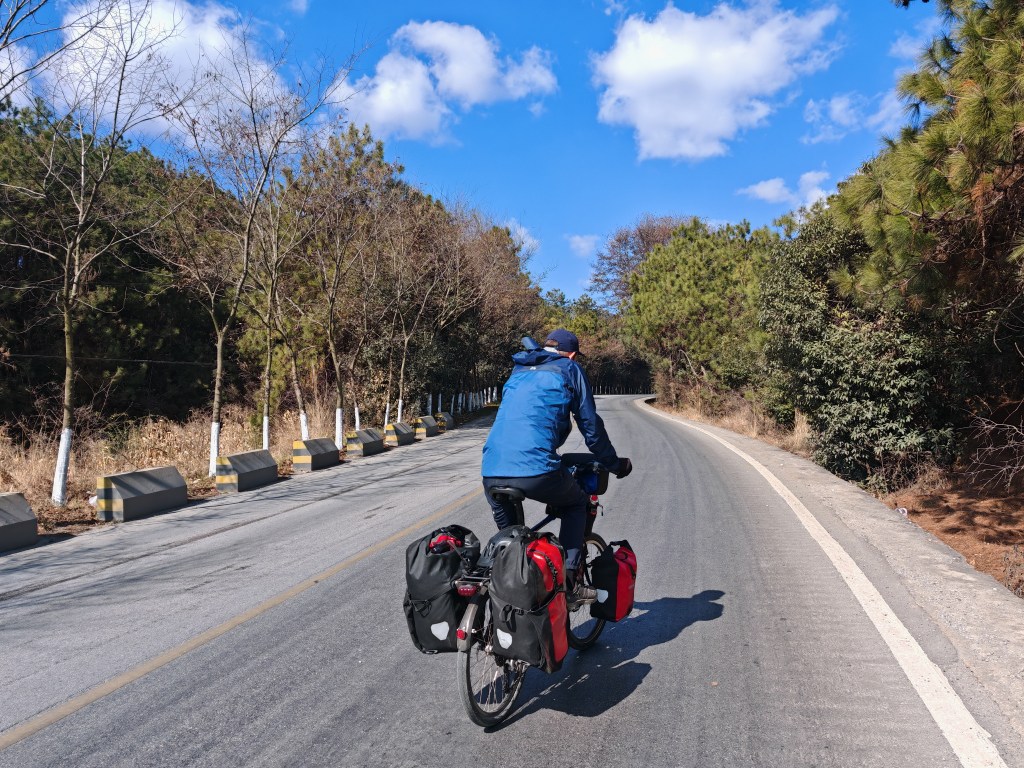
When the day is finally over we decide to stop for two nights, because this will be the last rest we can reasonably take.
Richard has run out of deodorant. We look everywhere, but cannot find any. He looks it up online, and apparently there’s a genetic variation where some ethnicities do not produce much body odour and don’t need deodorant. Sadly, Richard is not one of these. We are able to find women’s deodorant, because obviously we have to smell like posies and roses, but I have to endure a naturally-scented Richard for the time being.
Apart from all the staff from the hotel and the nearby car park, we are the only ones at breakfast in the morning. The woman working in the kitchen jumps up when we walk into the room, and encourages me to try some noodles with a spicy pork sauce. My poker face needs some work; I don’t think I am able to hide the fact that I just can’t face noodles for breakfast again, as spoilt as that sounds. She dashes off into the kitchen, and while I worry that I’ve caused offence, she re-appears with a plate of freshly fried eggs and puts them down in front of me, and is delighted at how welcome they are.
We set out for our last big push to our last destination, and our last monstrous day. We can see Jade Dragon Snow Mountain in the distance from almost the start. Much nearer, and partly obscuring it, is a large cement plant. White, with several chimneys jutting into the air, in a blanket of mist and ice, from a distance it looks like it could be one of King Ludwig II’s fairytale castles set against the Bavarian Alps. And I can continue the illusion until we are engulfed in the smog from it.
The town with the cement plant has doubled down and added a huge stone masonry, and in the distance are more industrial plants belching out thick smoke. No wonder so many people here smoke; it is preferable to inhaling whatever this shit is. It is miserable just breathing. There’s a layer of white dust blanketing everything, which, if you weren’t actually here could be mistaken for frost on the trees, but if you are here, just worryingly clogs you throat and lungs.
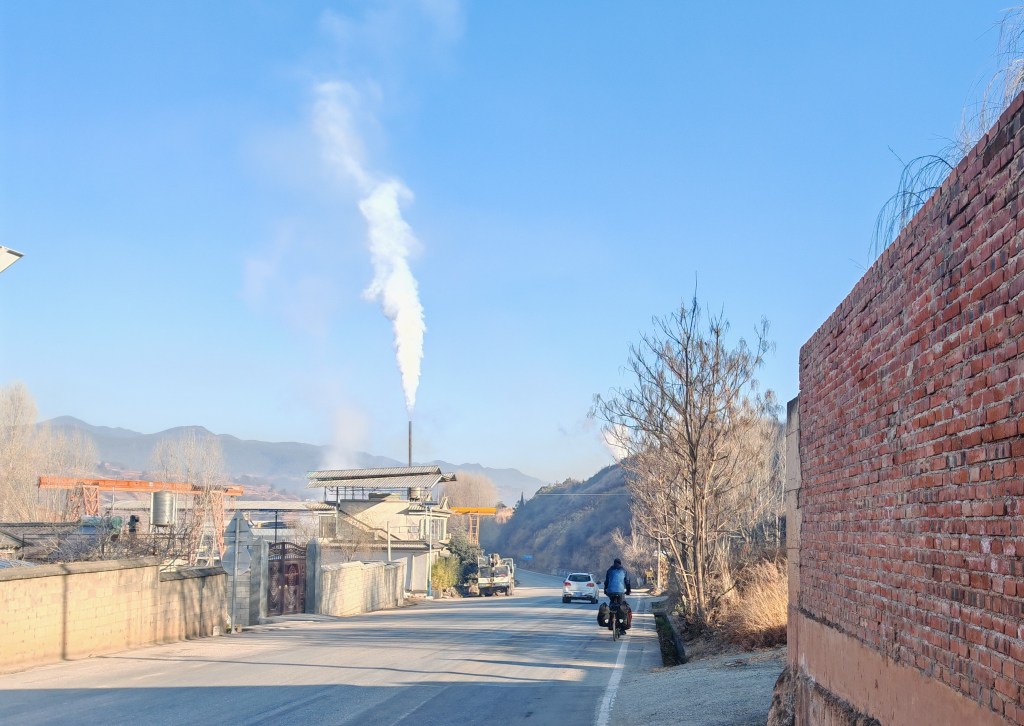
In contrast, above the pollution, the skies are bright and clear; we both notice that we hardly see a single cloud the whole time in China, and we also don’t see any flies or other insects. The latter fact gives us confidence when we see all the butchery by the side of the road and raw meat hanging around. Neither of us is remotely ill in China, despite that being a problem which has plagued me almost everywhere.
We near the end of our ultimate climb of the day, and Richard rides past me and shouts “We have goodies!” before powering off out of earshot, which is a bit unfair.
There’s a village square at the top, so we pull over for a rest and to put more layers on for the upcoming descent. A van driver has handed Richard some bottled yoghurt and a pack of buns before driving off. I had wanted to get some of the yoghurt the day before – it’s a famous product in this area – but it’s sold in glass jars so had decided against it. It makes a nice treat for us at the end of the climb.
The descent is hair-raising. It’s very steep and the road is very worn, so that it looks slick in the shadow. It’s fiercely windy. The mountains surrounding us are spectacular though, and the views are clear and sharp now we’re past the smog of the morning. I have never seen anything like the mountains on this day. It’s hard to concentrate on the road, when I’m gawping up at the scale of what is surrounding us.
There are some bridges which are so high that they give me the wobbles, even though I resist looking down. We also catch glimpses of the even higher bridges and tunnels of the nearby expressway, and see first hand the extraordinary engineering which is almost as awe inspiring as the natural landscape. What China has done here is almost beyond comprehension to people from a country that holds birthday parties for potholes that don’t get fixed for years.
It’s a satisfying payoff for what we’ve done, and bodes well for what we think will be the grand finale to cycling here. It’s been so hard, I hope it’s worth it.
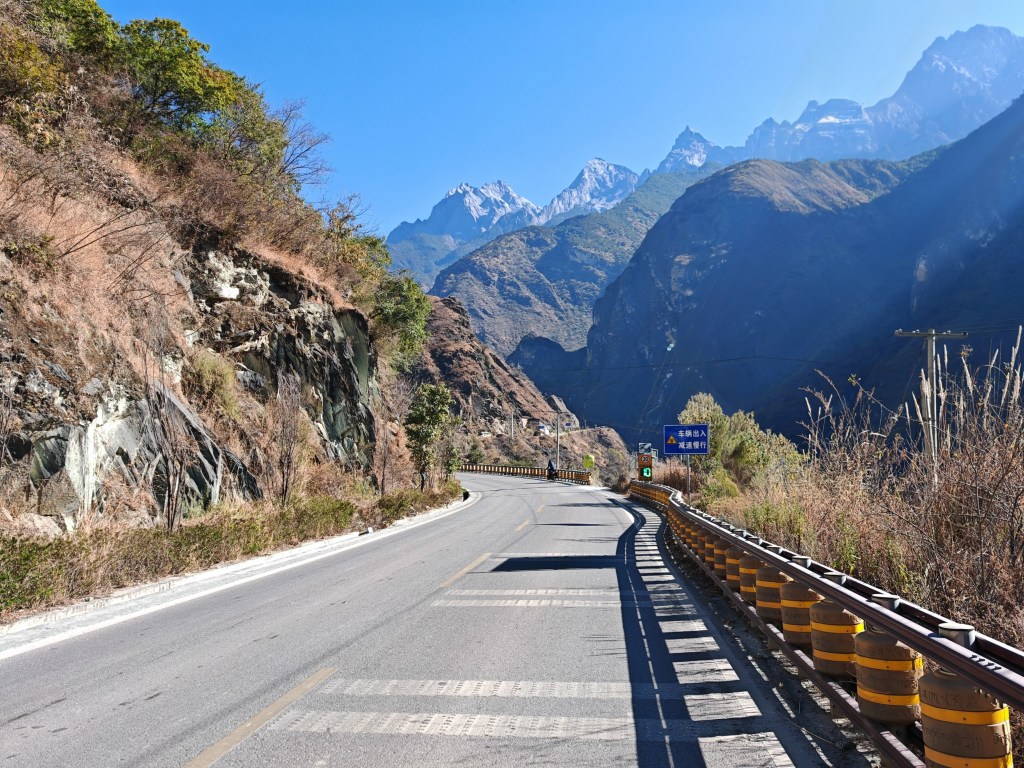
I read about Tiger Leaping Gorge in my early twenties when I first dreamed of cycling to China, and it’s loomed in my imagination ever since. I’m aware that I have somewhat dragged Richard here. And I’m aware also that he has not been enjoying China much at all. But I’m ruthless about wanting to come here, and I can’t leave without riding to this place.
It is minus ten degrees in the morning, but we have the luxury of a short distance to take in the gorge, so we can afford to wait until nearly 10am, when it’s a scorching minus four.
Most of the climbing is in a short space of time, and it’s painful and dramatic. We get some thumbs up and clapping from the Chinese tourists who have stopped to look at the various viewing points, so can preen around in the glory of that. The road is quite narrow, but drivers are sympathetic and give us lots of space. I don’t like heights at all, and I was worried it would cloud my enjoyment of the day, but it’s not as precarious as I thought it would be. Until recently, the sheer drop down to the river over 1,500 feet below was barely protected, but now there is a large concrete barrier, so even though it’s windy it feels quite safe.
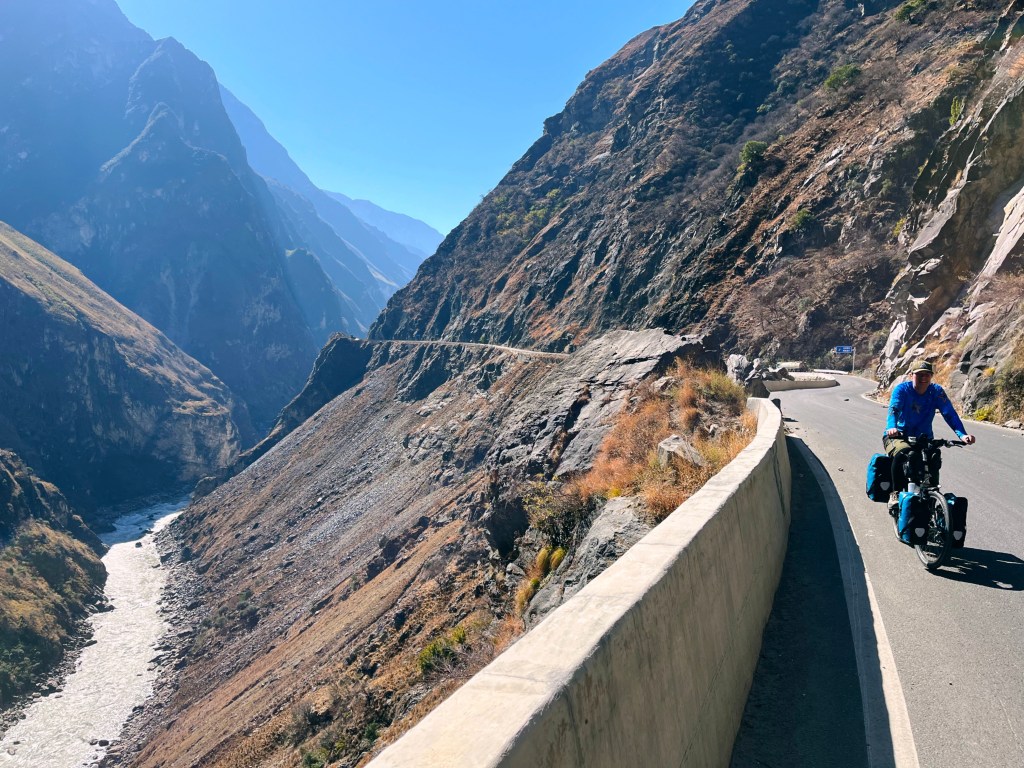
It’s the third deepest gorge in the world, and it’s dramatic and magnificent.
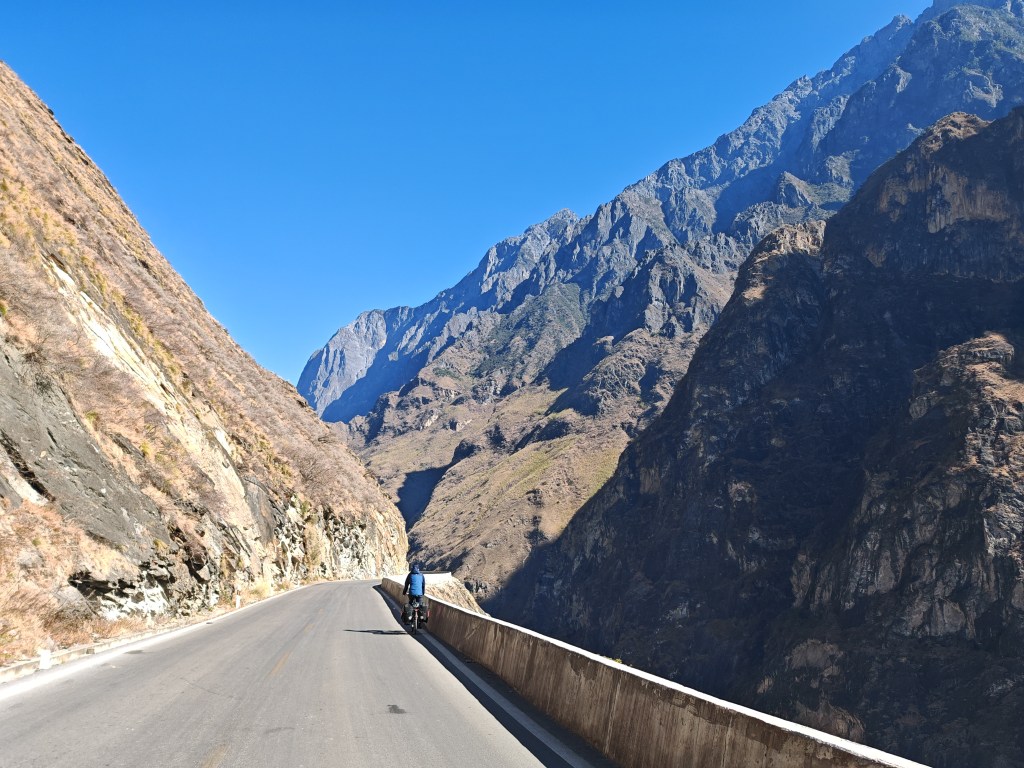
We stay at a homestay and we’re the only ones there, being the middle of winter. We thought on our day off we’d walk one of the trails, but it’s so ferociously windy it stops us in our tracks. It would have been almost impossible, and very dangerous, to cycle in this.
We make our way to our last destination here – Lijiang, known as the prettiest town in China. The old town district is picture-perfect: Gate towers, kui roofs (the kind that rises up at the corners,) intricate carvings, lanterns, a backdrop of towering mountains. If, like me, you’ve always dreamed of China, this is probably what you’d imagine.
We’re not staying in the old town so, like everywhere we’ve been here, it’s small local places to eat. We find one place popular with workmen that is very welcoming to us, and go there most of the almost week-long stay in Lijiang. After the toil of the previous weeks we gorge ourselves on the food, which has been one of the highlights of China, and is second only to Nepal. I go nuts on the first night and have a whole duck all to myself, and it’s sublime. Once Richard sees that the head, with eyes, is still attached he wants no part of it.
There are often no menus here, only pictures on the walls with the Chinese names of the dishes. We’ve ordered enough for four people (or just two cyclists) and start to worry how much this meal including a whole duck will be. But people here are scrupulously honest. If there are no prices, we always feel we’re treated fairly. I don’t think there have been inflated prices for us, no one has tried to scam or take advantage of us, and nothing given has strings attached.
The ability to trust in the honesty of the people here has stood out, but overall it’s been a challenging place to travel. The onus is on us, of course, to speak some Chinese and not on Chinese people to accommodate us. But on top of the difficulty of the language, when people are not hospitable, which they are often not, there is no effort to meet us part way. In other places where we don’t share a language, people have been keen to try and help, keen to understand what it is we are trying to say. And it’s hard to know sometimes if we are mispronouncing words, or are just being ignored, which definitely does happen. The lack of smiling, and the lack of common gestures and facial expressions, has kept us off balance and not understanding where we stand. We have felt more isolated here than anywhere else. On the other hand, the people who have helped us have put their hearts and souls into it. When people are warm and friendly it isn’t superficial, and they have been some of the most wonderful people we’ve ever met. I will never forget our hosts in Dali and how they looked after us.
It’s also been surprising how socially isolated China is in the age of instant communication and spread of information. You would expect that modern technology would bring us closer together, but in the case of China it has separated us even further. It’s amazing how the use of entirely separate social media makes us more disconnected from each other. On the other hand I can’t help but envy that China hasn’t been invaded with the onslaught of monoculture, or of American defaultism, that dominates our online world.
I’m glad we came here. It has not quite lived up to hopes, but if nothing else we’ve proved to ourselves what we’re capable of. I’m not scared any more of the road ahead, that I can’t climb mountains, and I’m proud of what we’ve done. But I don’t want to do it again.
A playlist for the ride:
 Ride & Seek
Leave a comment