
No one else gets off at Chongde station. And the station is the only thing that’s there. No town, not even really a proper road. I know Richard is thinking that I’ve made a mistake, and then he verbally confirms this, but I’ve spent ages plotting the best way for us to see the gorge as we go passed without riding miles and miles to get to it, and I’m sure this is right.
Things are more promising when we merge with an actual road, and then another larger one. The scenery is becoming more dramatic as we go, and as we turn a corner we see the outermost, and most major, bridge crossing the Liwu River that has cut Taroko Gorge. Most of the traffic crosses the bridge, while we continue on. There are now steep cliffs rising along the side of the road, and a glimpse of a macaque leaping back into the undergrowth as we pass. Some kids frantically wave and shout hello as we ride over a small rise, and then it’s downhill to the Jinwen Bridge crossing. It’s beautiful, and just seeing the entrance to the gorge itself is something I was worried wouldn’t be possible. The obvious road along the river is the one I really want to go on, but there are “No Entry” and “No Right Turn” signs, as well as some other warning signs in Chinese.
We cross back over the bridge, and continue on the other side, up a small but sharp climb and into a long road tunnel. It’s impossible to see to the other side, but with barriers on the opposite side of the road it’s clear that it is one-way, which feels much safer than it would otherwise. There’s then a second tunnel with a rest area in between, where we stop and admire the views. We’re not far into the national park and it’s already well worth it.
The second tunnel is longer, but well lit and with very little traffic. The opposite lane takes a different exit half way through and across a bridge, and with traffic now coming the other way, we see that the road directions merge here. This is great news, because it means we’ll be riding the other side of the river on the way out, and will get to see some of both.
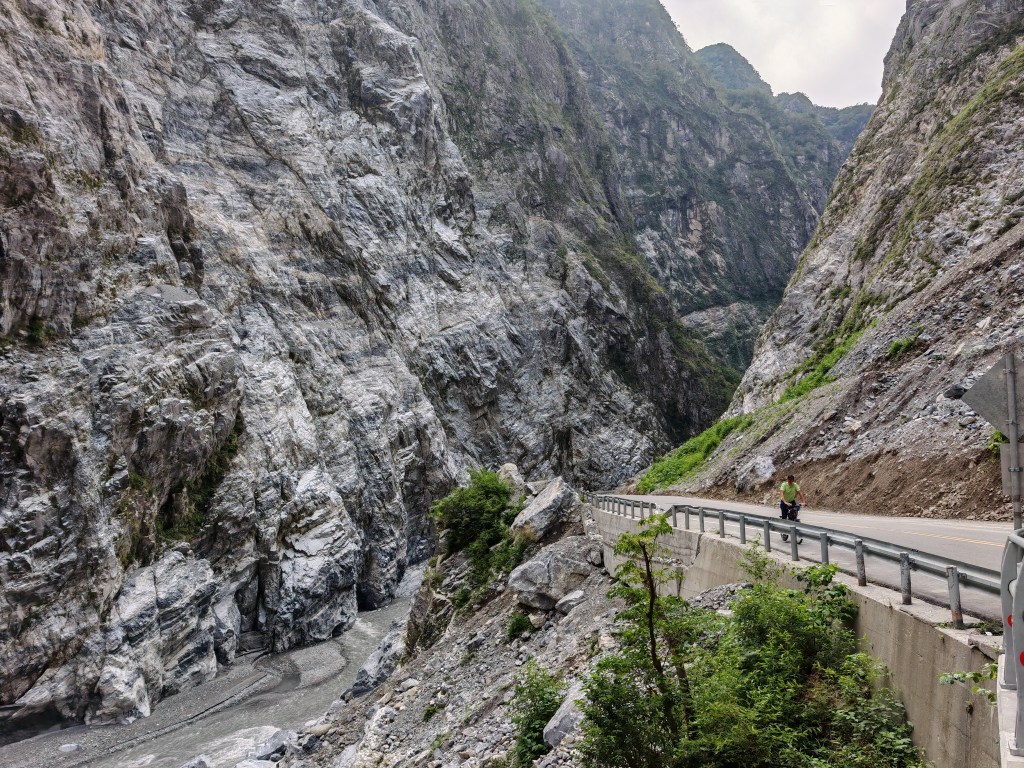
It’s grey and overcast, with a moody sky, and grey silt along the shallow, wide river. The cliffs are steep on both sides and mostly covered in vegetation, but with patches of the silver-grey rock face shining through. There are high waterfalls dropping into the river and several temples and shrines perched amongst the cliffs.

None of the walking trails, shrines, temples or other tourist sites are open in the gorge national park. They have all been closed since a devastating earthquake a year ago, and are unlikely to open any time soon. And the road, which forms one of the few cross country highways, is itself only partly open. It is closed between certain times for work to continue on sections, so we can only go a short way in.
We take our time at the most scenic spots, and find a place to stop and eat the lunch we’ve brought with us. The road starts to wind upwards here, and we’re unsure whether to go further on. We don’t quite know the procedure for the road closure, the afternoon is ticking on and we still need to ride on south to the place we’ve booked for the night. Our decision is made as it starts raining. We get all the way back to one of the tunnels before the rain gets really heavy, and we’re able to shelter in a service area and wait it out.
When the rain clears, we have a downhill run with no traffic through the tunnel, over the bridge we saw on the way up, and then along the other side of the gorge. The small tunnels here are carved in arches through the rock. We disturb some more macaques, but don’t stop. With the rain delay we’re anxious now to get to Hualien before dark. The guard beside the bridge lifts the barrier to let us through – the road is now closed going into the National Park, but anyone inside can still get out. Fortunately once we’re back on the main road it’s an easy ride with the wind behind us. It’s Richard’s birthday the next day, so we picked out a nice hotel and then they upgrade us to an amazing room.
Once we leave Hualien heading south, we are able to pick our way on small, rural roads through rice fields, and so for the next thirty kilometres it’s very pretty. But after that there’s only one road and the rest of the day is frustrating, because we can see very little of what we thought would be some nice views. It’s a beautiful part of the country, but on a four lane highway, with an additional two small lanes for motorbikes, it is not a scenic or pleasant ride. We get glimpses of the mountains on one side of us, but the train line and its fencing blocks most of it.
It starts to get very dusty, and at first we think we’re near a cement plant and the grey powder is some spillage from that. There are a huge number of roadworks and heavy vehicles, and it’s horrible to ride through. The grey powder gets thicker, and it’s now wet, so there’s an unavoidable thick grey sludge on parts of the road. There are concrete barriers narrowing the lanes, it doesn’t last long but there’s not room for anyone to pass, so a queue of lorries builds up a bit behind me, until the road opens out and crosses a huge riverbed. And looking to the left, towards the sea, is an enormous collapsed bridge, and it dawns on me that this is where the landslide happened following typhoon Ragasa. The grey cement-like sludge is the mud and silt, washed down by millions of tonnes of water after a dam broke in the typhoon.
The next township is Guangfu, the worst hit place where eighteen people died in the landslide. There are banks of the grey sludge, and houses destroyed by it. There are mounds – several stories high – of the landslide mess. On the one hand it’s amazing how quickly this has been cleared, with the road fully open and life going on as normal. On the other, the amount of destruction wrought is sobering, with mountains of the silt and debris piled up, and so many homes destroyed. I later learn that tens of thousands of ordinary Taiwanese travelled here to help with the clean-up.
As soon as we’re passed the township, the traffic lessens and so does the silt. We stop near where we’re staying, get out a massive pack of wet wipes out and set about cleaning up a bit. The bikes, panniers and our legs and feet are covered in grey mud. We can’t do much about the bikes, but we’re in a homestay so don’t want to turn up like this and don’t want to trudge this stuff inside on our feet and bags.
The owner is a lovely women, who seems to have known we were here or been looking out for us, as she appears from down the street chasing us when we arrive. She’s one of those people who can communicate without a shared language. Somehow, without using words we can understand, she lets us know that we are welcome to use the hose out front to wash our bikes, she can do laundry for us if we need it, and tells us where the nearest shop is. There’s nowhere open to eat yet, so after a good shower we get food from a convenience store. It sounds a bit sad, but it is really common here. Even in small versions of 7 Eleven and Family Mart, there’s always a good selection of microwave food which is heated up for you, almost always hot tea eggs and baked sweet potatoes on the go, and often tables to sit at and eat at. At school and work closing times these shops become packed with people eating in them.
The next day starts off in complete contrast to the majority of the previous one. Almost immediately the landscape opens up into carpets of rice fields, flanked on either side by a range of mountains. We decided against cycling along the coast to see exactly this. It is the East Rift Valley, and it’s absolutely stunning. This narrow, fertile plain sits between the coastal and central mountains ranges, and runs down the boundary of the tectonic plates which formed not just them, but the island itself. While coastal scenery can be had in a lot of the world, this place is more unique.

For as long as it lasts, it’s beautiful. But once again our peace is interrupted by huge sections of unavoidable road works, and unfortunately it means we can’t access the cycling bridge and along with it the marker at the junction of tectonic plates, so don’t get the obligatory photo of that.
Partway down the valley, we take the time to ride around the Paradise Road and Mr Brown Avenue area. From what I can gather the former is named after a coffee advert in Taiwan which featured this landscape, and from there it became a popular tourist spot. There are now a series of lanes and roads winding through the rice paddies, and it’s become a trendy place to visit and hire bikes or buggies to explore the area. We are here very close to the second of the bi-annual rice harvests, so the paddies are turning golden brown. The skies above are turning dark grey and threatening rain, and Richard’s patience with pottering around on little roads, rather than heading straight to our destination, is wearing thin.

When we reach the southern end of the valley, we have a decision to make. We’ve got flights booked now and not long left in Taiwan. There are a couple of things we’ve missed out, Sun Moon Lake being the major one, but the draw of Taroko is stronger. We get the train back up to Hualien and base ourselves there for a couple of days. We can now get a local train in the morning to as close to the gorge entrance as we can, so we can go back there, this time without the panniers. We’re still restricted by the road closures, since we need to get in and out of the same entrance, but we’ll have plenty of time to explore a bit more.
The train back north to Hualien is, if I’m honest, much more scenic than it was cycling this route.
On our second visit to Taroko, we have a bright day, unlike last time. We climb up passed the point we got to before, over some more bridges and through a series of long tunnels. Coming out the other side of the last one, and it takes my breath away. Taroko is one of three gorges in the world that cuts entirely through pure marble, and the results of that are almost unreal. The sun reflects off the marble and it feels as though we’re cycling through a mountain range made of silver. It’s probably the most astounding landscape I’ve ever seen, and it keeps getting better as we go further on.

We’re into the time when the road is closed. It is gated off at either end, but we understand that anyone in the closed section when that happens will be let out when they get to the exit. I can see on my GPS that we’re near the north gate, so we need to turn round soon. If we go through it we won’t be let back. There are several other groups stopped for a picnic in a stunning part of the gorge, where it has opened out into a huge clearing, so we do the same and eat our lunch.
We are the last ones to leave, but only just. Back the way we came we make it through one tunnel, and then get to an open-sided tunnel with some cones blocking part of the road. Out of a road crew, a woman shouts at us to stop as we’re about to pass the cones. She tells us work has started and the road is closed. It’s gutting because the four vehicles who left the clearing slightly ahead of us had clearly been let through. But I don’t think arguing will do us any good. I think our case is taken up by someone else though. Another women on the crew is clearly very angry, she is shouting loudly at the first woman and gesturing around. This is really unusual in Taiwan, but she doesn’t let up. For us it’s a bit of disaster. The road doesn’t open again for a couple of hours, so we’re stuck here. We’ll miss the only train we can get back, and cycling back will be in the dark. The view at least is mesmerising. The angry woman takes off in disgust up the road on a moped, after a few parting shots at road block woman. A short time later a pickup truck comes from the same direction, and the man in it says a few words and points at us. Road block women calls to us and gestures that we can go through, saying the man in the car is her boss. We follow the car passed some heavy machinery and work groups, and then he leaves us behind and we’re in the clear. There is no traffic at all now the road is closed, so we have the National Park completely to ourselves.

We know having been through this section before that there’s no work going on, so we take the liberty of taking our time. There are a couple of side roads that we can ride partly into before they are fenced off, and lots of scenic spots where we can linger a bit in solitude. Seeing the gorge from the opposite direction reveals things we couldn’t see on the way up. There are some older routes through the park, disused due to collapsed tunnels and bridges. One of the tunnels has been completely taken out by a huge boulder. Some of the roads are split open, or buried under landslides of rock. Taiwan experiences fairly regular earthquakes and typhoons, so we don’t know when or what caused all of it, but the boulder tunnel looked quite new, so that was likely the earthquake last year.
Back at the station, we’re feeling thankful that we make the train, that someone interceded for us to be able to, and that we got to see this incredible place twice, when it looked likely we wouldn’t get there at all.
A lady joins us in the lift to the platform. She says to us “Welcome to Taiwan. I am a Christian like you, so God’s blessings on you. We are all brothers and sisters.” No one is immune to making assumptions, but she is right about the last part.
There is a typhoon on its way to this island, one that has just pummelled the Philippines with death and destruction. We’re getting the train again, this time back to Taipei, because it’s probably the best place to be to wait it out for the few days before we leave. A French couple see us packing up outside the hotel and they are kind enough to worry for us about typhoon. They make sure we know about it and aren’t going to attempt to cycle. They are cutting their trip short to get out of Taiwan. At the station we meet a pair of cyclists from Scotland/Austria who have come here to do the circuit. They are also heading north on the train so as not to get trapped further south.
When we arrived in Taipei just over a month ago it was brain meltingly hot. This time it rains almost constantly. The typhoon is downgraded to a tropical storm when it reaches Taiwan, and its central path is now going south of us – where we’ve just come from.
I complained intensely about the heat at the beginning of our time here,
(and in all fairness it was Taiwan’s hottest October on record) but in reality we’ve been unbelievably lucky to escape with only that experience of extreme weather. We were in the west when the landslide devastated parts of the east, in the far south when a tropical storm hit the north, saw Taroko in the only possible window it could have been seen, and got back to Taipei just before flooding affected the place we’d just been.
I’ve had a heavy heart leaving many countries, but feel everything is done and wrapped up here. Taiwan is an amazing place with one of the most jaw-dropping landscapes I’ve seen. I’d recommend it to anyone, but (ironically, considering the big play made of its cycle route) it was one of the few places I felt would be better to visit on two feet and not on two wheels.
A playlist for the ride:
 Ride & Seek
Leave a comment