
The ferry from Palermo to Tunis books up a long time in advance, so we knew it would be busy and were expecting queues when we arrived at the port. What we didn’t expect was needing to have a return ticket back out of Tunisia. It’s a new requirement – too new to appear on government websites – and we were not prepared for it. The ferry company insisted on us signing a disclaimer to say we’d been made aware of the requirement and they weren’t responsible for bringing us back if we were refused entry. There is no usable land border exit from the country, so we needed flights. Our data had run out for Italy, so we scrambled around to find a cafe with wifi so we could book plane tickets out of Tunisia before we’d even got there. Under time pressure, we just picked the cheapest flights we could find, which were to Munich for just over a month’s time. We can always change it.
Boarding the ferry, we were directed to join the foot passengers rather than the vehicles, which is really unusual and really annoying. The foot ramp clearly led to a doorway to a packed luggage room where very obviously the bikes couldn’t be stored. It took us getting to the front and having no choice but to block everyone’s way until someone came over and let us through a gate to the car deck where we could leave the bikes and where we could have just gone in the first place if everyone wasn’t a moron.
It’s a long crossing, and even though it’s not overnight it is a really busy route, so we booked a cabin hoping to get some rest for the ordeal we expect at the other end. Tunisian customs and passport control at the port are not known for being efficient or welcoming. It’s unusual for us to not just go for the cheap option, but it was a good call. The ferry was heaving. There were even people sleeping in the soft play ball pit when the benches and floors were taken.
Two hours before we’re due to dock, there’s an announcement that everyone is to gather for disembarkation. This is great news. It’s a late night arrival with a bit of a ride and a border to deal with. But the early arrival turns out to be a lie, and we are all left standing crammed in the hot vestibule for two hours.
We plan to do everything we can to be vehicle traffic and not foot passengers. We race off the ferry ramp and ride breezily past the first guard, sneak past the second, but are flagged down by the final one. He doesn’t know what to do with us, so we motion towards the passport booths in the car lanes, but he checks with a colleague before directing us to the huge mass of foot passengers. Bollocks. The entrance to non-vehicle passport control is up a couple of flights of steep spiral ramps. There’s a guy at the bottom pre-checking passports but eventually the tide of people is too great and everyone starts piling passed him. People are pushing and shoving in one big bun-fight to get to the immigration booths. It is pandemonium. The bikes are a complete pain to manoeuvre around the spiral ramps and then through the queues and piles of luggage in the main building. Everyone has huge amounts of stuff, and we get more and more hemmed in until there’s no room to move out of anyone’s way. Someone is screaming in my face to move my bike, but I can’t. It’s been a frustrating few hours and nerves are frayed.
Eventually one of the border police sees some sense and directs us and some people with prams passed the crowd to put the bikes and buggies out of the way while we carry on queuing. There’s open resentment when it looks like we’re getting special treatment as we’re escorted to the front. And even though the guard fastidiously places us back in the press where we were before, the people behind are still objecting to us being in front of them. It’s a really unpleasant atmosphere.
Up past passport control, people are having all their belongings removed from their bags and thrown and strewn over the long metal tables where the customs officials are rifling through everything. I’d heard about this particular part of the ordeal that is involved for a non-Tunisian arriving here, but was hoping it wouldn’t be as bad as it’s made out to be. Oh well, that’s to come.
With our flight tickets and our first accommodation booked, we have everything in order to show the passport people. This is the part we’re confident will be straightforward. I’m stamped in, but there is a problem with Richard’s passport. The border guard leaves without explanation, and the tension from behind us is palpable as we’re causing a delay for everyone else. The guard comes back with border police and Richard is taken away. After a long and sickening wait a police officer comes over to me to say that he is going to be okay, which is not reassuring to me at all. Eventually Richard appears. He apparently has the same name as someone wanted by Tunisian police and had been in an underground interrogation room while it was sorted out.
By this time we are the only arrivals left, and we steel ourselves for the humiliation of our pants being sifted through. But the customs guards must be bored and tired by this time, and they let us through with just x-ray scans of our bikes and belongings. When we’re outside and our GPS unit kicks in, we discover that we are on the opposite side of the port’s inlet to where we thought we’d be. It’s still a 15km ride to where we’re going, but 10km less than we anticipated. At nearly 2am after a stressful day, this is a huge bonus.
It feels great to be out in the cool night air and to stretch my legs. And as we zoom through the outskirts of Tunis with the wind in our hair and the freedom to ride where we want, I’m reminded of why we are travelling by bikes. The city is mostly asleep, but there are late night restaurants and coffee shops still open, with the smell of spices wafting in the air and the surprised looks of passers by as we race north.
About halfway to our destination there are a huge number of police and army guards and the road is blocked with barriers. The police direct us away from the area and we scramble to find another route to where we’re going. I have to admit that a security incident in Tunisia is not something I want to experience.
The road passes some of the ruins of ancient Carthage which are deserted and cast in moonlight. It’s exhilarating and beautiful and I suggest we go and walk around them with no one about. Richard is not at all interested in sightseeing in the circumstances or at this time of night. I have to stop though for a look at the Malik Ibn mosque, which is lit up and glorious at night.
We have booked a guesthouse outside Tunis to the north due to cost and the Roman sites being more accessible here. We arrive at an heavy ancient wooden door in a wall and don’t really know what to expect. We’re greeted warmly by a guy who can’t do enough to help us. There is a pretty inner courtyard where the bikes can stay, the room is incredible and the thick stone walls are decorated with antiques and lots of historical reminders of the Fellagha and Tunisian independence.
We have a couple of days here to find our feet and do some sightseeing. The town is bustling and dusty, with white-washed buildings, endless old-man coffee shops and an array of possible places to eat with no menus or signs or prices. We find a bank that accepts our cards – cash is king here – and pick a cafe to settle in and watch the world go by. Richard lived in a couple of Arabic-speaking countries as a child, but can now only remember the words for “thank you” and “milk,” only one of which is actually helpful. We get by with French.
The ruins of Carthage are very spread out. It is very much out of season, so we think it’s cool enough to walk between everything. We haven’t sorted out a Tunisian SIM card yet anyway, so we don’t really have a choice once we’re out and about since we can’t use the taxi apps. We visit one of the amphitheatres and it’s completely deserted, although fairly unimpressive. We stop off at a couple of the smaller and none-ticketed sights – a basilica and some cisterns – before a long walk to the primary site to the south. This is really impressive, although it starts to hail and we have to huddle under a tourist information sign near the Roman baths. Watching pebble- sized hail stones pelt down with the Gulf of Tunis framed with palm trees and ancient columns is not what I expected. When the hail stops we are able to walk directly amongst the ruins. There’s not a lot of preservation going on here, nothing is cordoned off or off limits. There is a beautiful mosaic which is not only open to the elements, but for visitors to just walk over.
On our way cycling south we are stopped by police in the same area as on the way in. This time the road is not closed, but the police officer asks us questions and goes through our bags. It finally dawns on me that this is the road past the Presidential Palace, and it’s heavily guarded during the day and closed at night.
Leaving Tunis, we take a route on a huge bridge which connects the expressways to the north and south of the capital. We’re probably not supposed to be on it, but nothing expressly says we can’t use it, and it means we avoid the city on our way south. There are loads of pine processionary caterpillars on the road, which are toxic to humans but I still don’t want to kill them, so try to take my mind off the enormous headwind we’re riding into by weaving around them. But there are thousands and I need to concentrate on the steep bridge and the traffic in the heavy gusts as we cross to near La Goulette port and truly begin cycling in Tunisia.
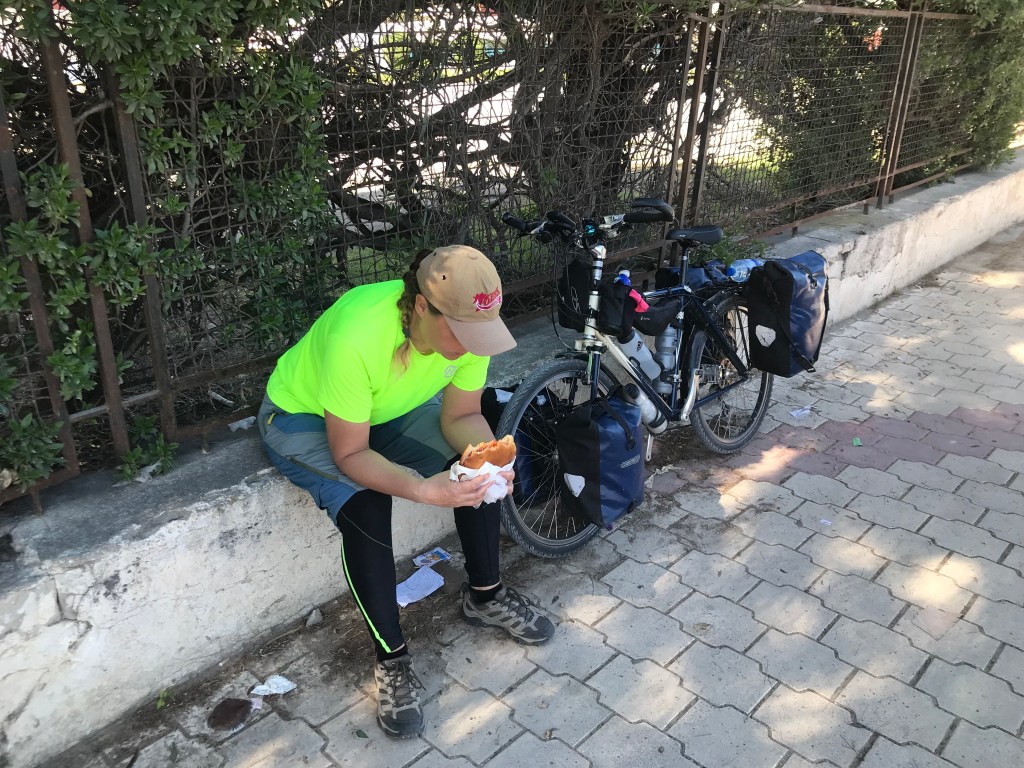
We’re able to peel off the main road not too long after the bridge. We then mostly follow a route that runs parallel to a motorway. It still very busy, often two deep with lorries and trucks, but the lanes are really wide and the drivers give us plenty of room. My main concern is always to be seen, but my luridly yellow top is attracting insects like I’m some giant mobile flower.
Now we’re on the road we’ll be taking for a way south, the adrenaline of navigating our way here dies down and we can relax a bit. We stop for our first coffee at a petrol station and realise we’re being stared at in bemusement as we excitedly point and discuss the various types of drinks in the fridges that are new to us. We sit outside and take in the dust and noise from a different angle, when a car sputters to a stop beside us having run out of petrol. Before I can blink Richard has leaped over the barrier like a middle aged super hero to help the driver push the car to one of the pumps. I get stung by a wasp thanks to my be-safe-be-seen t shirt.
The cycling is unremarkable. The roads are all the same. Flat, straight, dusty, monotonous. The towns are all the same too. Dusty, white washed, often lined with palm trees. It’s busy, but not as chaotic as I thought it would be. The atmosphere is mostly sullen or indifferent. But when we break the ice things do change a bit. I see an A-board with a picture of food and head straight for the accompanying establishment like a moth to a flame. It looks like someone’s kitchen, with some glass shelves showing what bread they offer, which in this case is just one kind. The man and his wife here are selling a kind of roll which is called a chapatie. But it’s not like an Indian chapati, it’s more like an enormous breakfast muffin cut in half and filled. Tinned tuna is the one filling that can always be banked on at these roadside stops, and the condiments are usually harissa, some kind of green chilli chutney and a garlic & yoghurt sauce. They are delicious; right up there with Vietnamese banh mi for a roadside pit stop.
We arrive at one town as our destination for the night which is really dead, and we’re sceptical that there is anywhere to stay. We find a hotel with architecture that looks like it belongs in Tatooine. I don’t think they’re expecting many guests, as we’re ushered into a coffee room like an underground sand cave, with dimly lit round alcoves, hookah pipes and stereotypical north African textiles on low cushioned seats and floors. We’re given coffee on the house until our room is ready. Everyone is very kind and welcoming. On our way to our ground floor room a lady runs after me and gives me an armful of toilet rolls, way more towels than we could need and enough soap to wash an elephant. We don’t actually have just a room, but a kind of apartment. There’s a central hexagonal room with a dining table, and doors to three bedrooms, a kitchen, a bathroom and the front door. It’s not salubrious by any means, but it’s still a bargain for about £20.
It’s about to rain so we hurry out to a food stall we saw on our way into town. Communication isn’t easy, but we nab ourselves a couple of spicy chicken makloub to take back to our apartment. These are amazing, and doubly so according to Richard because they were less than £1.50 for both. Once the rain has finally stopped we’re both hungry again and take a walk round the town at night. It’s even more deserted than when we arrived. The food stall is shut now, which is disappointing. The only place with lights on is a little takeaway place with some seats outside. Lots of tourists come to Tunisia, but we’re a bit of a novelty in a small town like this. The guy taking our order seems delighted with us. That’s usually because people love the opportunity to practice English, which is great for me because I feel like a bit of a dickhead for learning hardly any Arabic. We each order another kind of wrap with spicy chicken and variety of chilli condiments which we already love.
It’s freezing at night to the extent that I risk the dodgy wiring on an ancient portable heater in our apartment, because it’s hard to sleep otherwise.
We pay a visit to the Mos Eisley cantina on our way out of town for a great coffee.

We arrive at a seaside resort town the following day. Out of season we are able to get a room at a tourist hotel for a really good price, so decide to stay for a couple of nights and wander to the beach. I am fairly certain we are the only ones there. We do our usual scout for a good coffee and then a wander round. Like the other places we’ve been, parts of this town are empty and much of it is crumbling. We’re quite happy walking round, but there really is nothing to see. A man pulls over and greets us as though we know him. He explains that he’s the chef at our hotel and offers to take us where we want to go. The idea that we’re staying in a hotel with a chef is pretty laughable. Richard is more relaxed about it, but I’m unnerved by a scam that involves trying to get us into his car. We find another great chapatie place though. This one has omelette on offer as a filling and an even more amazing spicy sauce than the others, and I can’t get enough of it.
Back where we’re staying the guy at the desk is keen to talk, with probably nothing else to do since no one else is here, and mentions maybe we might want to stay longer for the start of Ramadan. Ramadan. Oh shit. Not something I had even considered. Sure enough, fasting starts in a few days’ time and we are in the middle of Tunisia. The last Ramadan we were in Malaysia, which turned out to be fine because the Chinese and Indian communities don’t fast and we were always able to get food. That won’t be the case here. We ask around in general and then on some online forums and get the same answers – even in Tunisia’s biggest tourist resort there is one cafe open in the morning, serving drinks only. In Malaysia all the Muslim restaurants were shut in the evening, as people broke their fasts with their families. No reason to think it would be different in a more observant country. So eating at restaurants, food stalls and any other served food place will be off the table (ha!) The reality is that if we really wanted to make it work then we could. We could buy food in supermarkets and eat that for the rest of our time here. But neither of us is up for it. Tunisia is fine, but in the nicest possible way it’s not particularly worth bending over backwards for, when the highlight of being here has been the street food that we won’t be able to get. We also know now that we will have to go home in a couple of months, and with half an eye on that, my heart isn’t in having a big upheaval here.
So we give up on going farther south and into the more remote part of the country, and instead focus on getting ourselves back to Tunis in short order, but going a different way than we came so as to make it more interesting.
It isn’t more interesting, but it is slightly less dusty and we go through less towns. There’s a National Park with marginally nicer scenery than we’ve experienced so far, and until the final section, there is a lot less traffic.

On our first day of racing back north, I spot someone on the roadside tucking into a wrap, so I pull over and sniff out where it came from. A woman is at a hole-in-the-wall stall making a kind of pancake on a hotplate. I try asking for one, but she shakes her head and either doesn’t understand or is really reluctant to serve us. A truck driver comes over who speaks a little English and some French and is happy to translate. This and some smiles break the awkwardness a bit. The dough is freshly made and freshly cooked, and the filling is hard boiled eggs and tuna with the usual sauces. I think this type of wrap is called mlewi, and it is the best one we had.
Because we want to go a different way back, we make the unfathomably stupid decision to not use the large bridge we left Tunis on, which wasn’t perfect but we knew was really safe, and head into the city centre directly instead. Cue two terrified cyclists on an eight lane motorway, one of them pleading in her head that we make it through this day alive. We have our day glo tops on, so at least we should be seen. The fear riding on that road has taken years off my life and I’m exhausted when we take the turning we need. Riding through Tunis itself is bliss in comparison to what came before.

Ramadan kicks off, and though I feel like a bit of a quitter for not persevering onward into Tunisia, it does also feel somewhat justified as we walk for miles and miles round the city and there is not so much as a cafe open. There’s a supermarket we can buy food from to prepare ourselves, but so many things are shut or shut early that it’s a really boring time to be in Tunis. We’re staying in a small hotel and the staff invite us for an iftar meal on the second day of fasting, which is a huge treat.
Meanwhile we’re figuring out where to go next. I thought the flights to Munich were refundable, but it turns out they only were for a couple of weeks after we bought them and that has now run out. We now need to leave sooner than they’re booked for; sitting round in Tunis is already driving me insane. Plus the bike and bag policy of the airline is terrible. It will cost us about the same to buy new flights with a good policy than to change the ones we have. This misadventure into Tunisia has cost us a lot. We plump for flights to Marseille in a couple of days, and launch ourselves into the rigmarole of finding bike boxes in a place where no one cycles. We get lucky on the third place we try, and they give us them for free which doesn’t usually happen these days.
I have found Tunisia to be a lot of bother for no great reward, and although we didn’t accomplish what we set out to, I have no particular need to come back here. Richard is quite keen to do so though so we’ll see. Ahead, we have a clear schedule to get back home, but uncertainty beyond that.
A playlist for the ride:

 Ride & Seek
Leave a comment