
The border crossing is weirdly busy, and it’s pretty clear we’ll be here for at least an hour, until a taxi driver walks over and shows us to the foot passenger booth, and we’re stamped into Montenegro in no time.
The scenery looks rugged, and while some of Albania was still lush and green, this is fully stripped down and winter-bare. It’s all greys and browns. The first part of our ride is cross country and it’s the kind of hard rural life where farmers are out manually digging trenches and making fences with tree saplings tied with string.
Once we hit the main road though the heavy industry is apparent again, with whole hillsides dug up and lorries raging passed us. We have a massive downhill at the end of the day, but we are almost completely stopped in our tracks by an almighty headwind.
The first day in Montenegro we see lots of road cyclists, but never see another one the rest of our time here. I assume they have all been run over, since the driving here is somehow more deadly than Albania, and people seem to achieve this without the aid of raki in the morning.
I’ve been dreaming about this cycling trip for years, and remember the town of Bar being touted in travel guides as a quiet and charming seaside town. That must have been a lifetime ago. Now it is a giant building site, with a brand new and extraordinarily ugly giant church in the middle.
The ride along the coast is hair-raising. The roads, or rather the awful driving combined with the very narrow roads, have been the most dangerous I’ve experienced. I felt safer riding in Kathmandu or Phnom Penh than I do here. Richard manages to spot someone exiting a tunnel on a small road below us, and we pull up and peer over the armco trying to figure out how we get on that path. We wrestle our way down the hill on overgrown footpaths and a dirt track, but we’re prepared to do anything at this point to get off the road and away from the drivers. We find the road, which is actually a pedestrian and cycle way, and it goes downhill though a well-lit tunnel carved through the cliffs, and when we exit we’re on a beachfront promenade with layered sedimentary rocks jutting out from the sea. I have never seen the sea as clear as it is here.

The city of Budva is really lovely, or at least the old town is. We wander the cobbled streets and visit the citadel and city walls. The view out to sea and of the nearby coves is idyllic. Looking inland, there isn’t that much space to build since the steep hills abut the coastline, but it’s all being utilised to cram in ugly apartment blocks and hotels that don’t fit in at all.
The ride out of town is narrow, busy, uphill and dangerous. Near the top of hill we get an unexpected tunnel, usually that’s a good thing because it cuts out some climbing, but this is curved and unlit. We make it out alive, and just have to grit our teeth to get through the bulk of the day.
Finally, we swing into Kotor Bay and it’s like night and day. All the traffic has veered off to continue on the main road. The noise and danger has evaporated for us and we’re left to spend the rest of the day riding round the beautiful bay in relative peace. We stop to have a look at the Sopot cave, and again just to sit and look out over the water and eat our sandwiches. This region has been truly awful for littering, but all the bins of the Balkans are gathered round this area, and they seem to be doing a good job.

We’ve made good time and arrive at a guest house early, so they brew some coffee for us, and we have time in the afternoon to ride the other way along the bay and spend an inordinate amount of time faffing around in a shop deciding what to cook for dinner, only for me to end up making what I nearly always do – a meat variation of Turkish menemen.
We intended Kotor Bay to be a place to make some decisions about what’s next on the road. It would either be up into Bosnia and then Croatia, or over to Podgorica and see again from there. We agree that we’ve pushed our luck going north as far as we can. We’ve reached Dalmatia and been almost magically lucky with the weather. Even though it’s been bitterly cold at night, the days have been warm and several people have commented that it’s been the sunniest and driest winter they’ve ever seen. But there’s lots of rain forecast next week, so we decide against pushing further north.
I’ve had my heart set on riding a road called the Kotor Serpentine for a while. The 25 hairpin bends make it resemble a serpent on the side of a hill, hence the name. Thanks to search engines, I can’t really hide the fact from Richard that it’s a big climb, so he’s taken some convincing. The key is relentlessness. I launch only a few targeted campaigns a year, so I can concentrate on each one until it’s successful. The weather has limited our options anyway, so the Serpentine it is.
Leaving the guesthouse we start off on a small road right by the water. We are surrounded by the Dinaric Alps blanketed in mist, there is no traffic and the water is completely clear and still. The mist will clear by midday, and we’ll be left with a perfect day to do the climb, and get the views from the top. We pass through the city of Kotor, which looks very lovely, and I slightly regret not staying there, but we’d been hankering after peace and quiet. It’s Sunday and a band outside the church is getting ready to play.
As we leave the town the climbing starts immediately, as does the smell of goats and an orchestra of sheep, who are then joined by the sound of the band and the church bells from below.
This preliminary climb before the hairpins of the serpentine is comfortable. I think to myself that I can do this for hours, which is handy. The next stage of road meanders away from the bay through pine forest, where it’s damp and shady. Like Crisp losing the Grand National, I’m starting to lose concentration and am fannying around rather than getting on with it. My hat’s not comfortable, I need to stop to drink, to readjust my shorts, blow my nose, change my gloves, take my coat off. I start wondering if I’ll see lizards again soon when it gets warmer, where they fit on my list of favourite animals (5th I think,) why lots of Albanian words sound like Turkish ones, why Mercedes didn’t catch on in Montenegro and if I’m cold enough again to put my coat back on. Richard looks exasperated with me, and we’re not at the tight switchbacks yet.
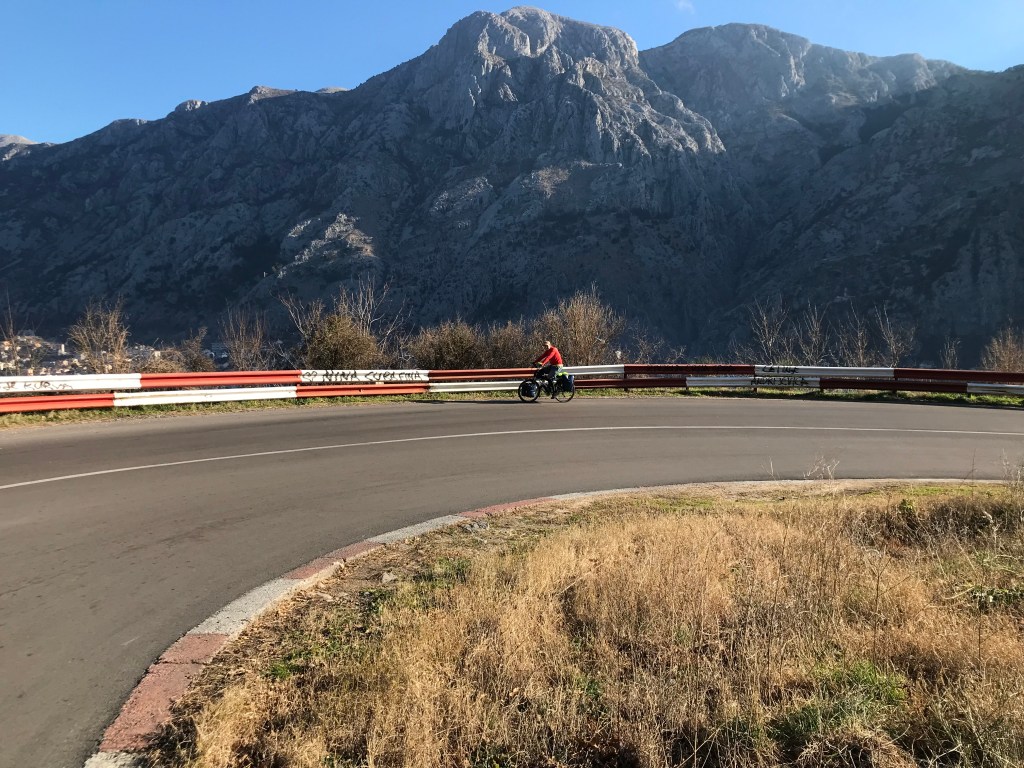
The road is really narrow on this section, and passing cars don’t slow down at all or move over when they pass us. One driver waves to us, which only brings attention to the fact that no one else in Montenegro has done that, or even said hello.
Once we get to the tight hairpin bends I’m back in form, and we both find the riding much easier than we were expecting. It’s a long climb but it’s a manageable gradient and it’s a consistent one. We get to the top much sooner than we thought we would and can spend our time admiring the scenery, which is almost dream-like. We’ve seen lots of incredible vistas in different countries, but this place is right up there.
We are not too far from a major town, but we saw that a family with a farmhouse in a mountain village was renting out a room, so we went for that instead. We’ve spent most of our short time in Montenegro so far in big cities and on major roads, so wanted to make a change and be away from all of that.
On the other side of the mountain there is snow on the ground so we have to take it a bit easy going downhill. We stop at a tavern in the village for some traditional beef soup. We talk about going back there for dinner later, but we’re too tired and just re-heat some pasta from the night before.
The morning has an eerie feel to it. Many of the rocks are white, there’s a fog hanging in the air, there’s lots of white-barked deadfall, and the hills are sprinkled with snow, so it all looks ghostly. The road is completely deserted and we have a climb straight away. The wintery views from the top are just as amazing as yesterday, though completely different. There’s a well-lit tunnel and then a downhill which descends into fog so thick that I can only just make out snow banked up at the side of the roadside, but fortunately there’s no traffic at all.

We have a really short day, thanks to the farmhouse decision, so can wander a bit round the historic Cetinje, a former capital. It’s freezing. I don’t have thermal gloves, so by the time we get to town my fingers are like ice and I can barely use the brakes. We warm up at a cafe, and I nearly clear them out of borek.
The next day is to Podgorica, Montenegro’s capital. I don’t fancy riding on the main road into it, given how dangerous the driving is here. So we find a series of backroads which could hardly be more different. They are too small for cars to pass opposite each other, and surrounded by the karstic limestone rocks that characterise this country. It’s much warmer after the descent of yesterday, and there are purple crocuses poking through everywhere. It’s barely populated, but when we do pass through villages they look like they belong in the middle ages. It’s hard to believe we are on the way to a capital city. The day is much tougher than we expected though. We’d overlooked the amount of climbing because the overall descent was so big, but the climbs are on short but agonisingly steep hills. The maximum effort it takes to get up them is followed by only very short breaks on the downhill bits. On a very heavy touring bike this kind of cycling is a killer, and far more painful than the consistent mountain of yesterday.
At the end of the day we get paid back for the climbing with a huge downhill approaching Podgorica, which is set on a plain with a backdrop of the mountain ranges of Albania. When we arrive on the plain it is the bleakest place I’ve ever seen. It’s what I imagine Chernobyl to look like, except somewhat populated. The centre is just as strange. The roads and streets are so unnecessarily wide, it’s as if they’re making up for all the other roads in Montenegro. Other than that it’s like a large Bracknell.
We’re staying a few kilometres outside the city as it’s a lot cheaper, but having our own transport means we can still use the city for the various chores we need done. We try all the bike shops we can find, but no one sells anti-chafing cream. We sit around at a cafe-bar waiting for a load of washing to finish at a launderette and are fascinated by the fact that there is pre-recorded dog racing from the UK being shown, and that people are betting on it, which isn’t open to corruption at all.
I’d wanted to see some of the national park land to the north, but the weather is really closing in now so we make do with a ride through the Cem canyon to the east, which we can do much quicker. Once again we’re blown away by how clear the water is and the canyon it’s cut is also incredible. Satisfied that we can’t do more in Montenegro at this time of year, we’re going to head for warmer climes.

We cycle out from Podgorica past the international airport. There is no traffic whatsoever this way and there is only one plane at the airport. It’s possible that this exit to the east is even more bleak than the one to the west. No one lives here and yet it is just completely covered in litter. There are some vast vineyards which is confusing at first on the flat plains near an airport, until I remember that the raki in this area is made from grapes, so this is about quantity rather than quality.
I’d seen a map marker on this road for “Niagara Falls” which at the time I thought was a decent joke to entice tourists to some poxy stream in the middle of this desolation. We’d been riding near the river, which cuts directly down and perpendicular to the plain, which looks pretty cool. Then I heard the thunder of water, but thought it was probably just a lorry coming for me, until spotting a small viewing platform up ahead. Sometimes things we’ve gone out of our way to see have been a disappointment because we’ve built them up, and then other sites like this are such a treat because they’re so unexpectedly good. We spend ages there, and health and safety has not come to Montenegro, so we are able to get to the edge of the falls and onto some outcrops partway down it.
In the afternoon there’s a ride uphill round a picturesque lake, and towards the familiar limestone mountains of Albania. There’s another national park here that I’d really love to see. I let Richard know so that the seed is sown for the future, but I have to leave it dormant for now. We have a couple of days of decent weather left and just enough time to makes it to Durres port, where we’ll get a ferry to Italy.
There are some places in front of us that we went through going the other way, but we mostly took different roads to get to them. We’ve learned our lesson now that main roads in this part of the world are not worth risking, however much time they save, so we take less direct rural routes. We pull up at a cafe we stopped at before and the manager recognises us and asks if we want the same thing we had before, which she has remembered.
Our entire second pass through Albania is amazingly friendly. It feels as though every other person smiles and waves. On the way into one town the local school has just finished and a group of the kids line up along the pavement and call out for high fives.
Our time in the Balkans ends anti-climatically, with hours of waiting around in the freezing cold at a ferry terminal for a night boat to Italy. Thanks to popular culture we know a few words of Italian, which means I can devote my time on the ferry to learning gelato flavours.
A playlist for the ride:
 Ride & Seek
Leave a comment