
A border crossing being on top of a huge hill is annoying until you’re the other side. We cruised down through the rugged hills heading towards the coast. It’s a totally different landscape, and more breathtaking than the last. The valleys are full of orange orchards ripe with fruit, which is extraordinary given the time of year. We stop along a small rickety bridge because it’s the only place to sit down and have a debrief and a drink before we continue on, and because it’s opposite a village of Ottoman-style homes by a lake which is very pretty and completely unlike the architecture we’ve seen so far. A young man in a souped-up car pulls over and asks if we are okay or if we need anything. It augurs well for the days ahead.
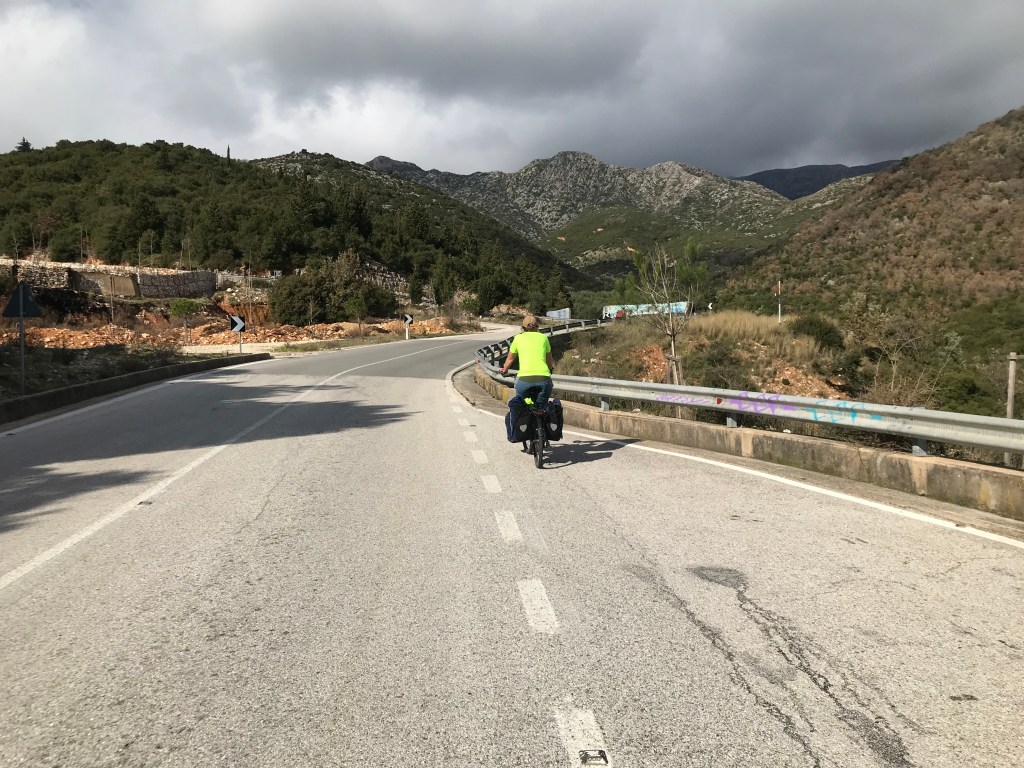
Albania has sparked more interest and comment from people we know than anywhere else we’ve been, which was an odd surprise. Several people have cautioned us to be careful here, probably fuelled by vague rumours of Albanian mafia and organised crime. There’s the joke about all Albanians owning a Mercedes. There is the excitement about this country as an up-and-coming holiday destination. I am fairly certain that if you search for “hidden gem/off the beaten path” breaks in Europe, Albania will be there. From our first day alone, the Mercedes joke is amusingly true, they make up probably about 65% of the cars here
Our aim for today is a small town by the sea, and we need to get a little boat across a tiny inlet, otherwise it’s not worth the alternative of taking the road all the way round. As soon as we turn off the main road the atmosphere changes. Not from Albania, but from Richard. He hates being on small roads that look like they go nowhere, like this one. Even though I’m certain we’re going the right way, it is low season heading towards a beach destination and he’s worried the boat won’t be running, and his dark mood about this kind of issue is always pervasive. He lightens up when some cars pass us, a clear sign we’re not heading for a dead end.
The boat is basically a few pallets tied together and tugged by a cable across the inlet, taking less than five minutes. A stray dog takes the pallet too, but otherwise we’re the only passengers. On the other side are the ruins of Butrint, an ancient Greek and later Roman city, and the reason I wanted to get the “boat” to the peninsula. The security guard tries to entice us to the entrance, and it’s a beautiful day, we have time, and the bikes would be safe under his eye. But we’ve planned a day off tomorrow for this anyway, we don’t have any Albanian currency to pay for the ticket, so we reassure him we’ll come back. We don’t come back.
It’s a few kilometres to Ksamil, where we’ve rented a cheap apartment, and as we roll into the place it’s clear that almost nothing is open. The tourist end of town is completely deserted. Supermarkets are chained shut, restaurants are locked up, no hotels are open, the launderette we wanted to visit is shut, ATMs are switched off. Most of the area looks like very new builds, this town is clearly experiencing, or expecting to experience, a tourist boom. But not in January. We walk around for ages and find just one place open serving food, but that’s fine we only need one place. The owner of the apartment accosts us on our way back to give us a bag of oranges from his orchard. If I didn’t know better I’d think we were in Turkey with all the kindness.
The following day the rain is hammering down, so we decide not to cycle the 10 kilometres back to the Butrint ruins to spend the day outdoors and instead decide to move on the following day.
Further into the Albanian Riveria it becomes clear just how much this area is gearing up to be a huge holiday spot. The Greek tourist towns over the border were like corpses, decaying and forlorn, looking more abandoned than just shut for the winter. Even though most things are shut here too, Albania is alive, vibrant and rolling in investment and hope. The way into the city of Sarande is lined with brand new hotels and apartments waiting for the summer for an influx of people to tear the shrink wrap off.
There’s barely enough businesses open for us to get by, but we find a budget guesthouse at the end of the day. We check we can keep the bikes indoors, and they wait until we pay before changing their minds and insisting they go outside on the street. We don’t have much choice but to leave. Down the road we find another place run by a guy on completely the other end of the spectrum, who can’t do enough to make sure we’re happy to stay. He is much more in keeping with the people of Albania as a whole.
The next day we have a steep climb immediately, which on a cold morning is tough on the ageing legs. It’s fortunate it’s so steep though. I stop near the top to catch my breath and have to use the brakes to prevent the bike rolling backwards, and that’s the only reason I notice that my front brakes aren’t working. I can’t figure out what’s wrong – the cable all seems fine, attached and properly in place. It takes a few minutes to realise that the brake block on one side is missing. It shouldn’t really be possible for it to just fall out, but it has. The bikes had a service and the pads replaced in Izmir not long ago, and from the look of the other pad they were just kind of roughly stapled in rather than fitted properly. We have some spares and I noticed the issue going uphill not down, so some nasty consequences are averted.

We have three days ahead of mountains, and we can see the snow-capped peaks in the distance that we’re heading for. I am a bit nervous about it, but Albania is already beautiful so also I can’t wait to get stuck in and see what natural wonders it has in store.
The first day in the sequence is the worst, though on paper it shouldn’t be. There are two separate big climbs, which completely do Richard in by the end of them. The first tips 12%, but still he’s off in the distance while I plod along. It’s inland and there’s not much traffic, and the only sounds as we wind our way upwards are goats bleating and cowbells. Eventually we get back to the coast on a long, steep downhill stretch, and though the views of the Ionian sea are gorgeous, I can’t keep out of my mind that if the brake block had gone missing here I would have been mincemeat.

The next ten kilometres are uphill, and at first I’m slower, then matching pace and by the summit I’m far ahead of Richard. It’s rare that it happens, but when he’s fully healthy it’s always on days that are especially long and often with dual climbs. He relies on powering up all the way, so when his energy runs out and legs are overworked, he hasn’t got a backup. I’m without the option of that much power, so I just accept the long grind of the day and settle into my slow steadiness from the start. The only advantage is that on the occasional days like this I can just keep going when he’s worn himself out. Sadly Richard isn’t going to appreciate this insight when he joins me at the top, so I restrain myself with a bit of light gloating softened with the offer of some yoghurts that I have in my bags.
It’s been so cold at night that we’ve avoided camping. It was regularly getting down to -5 degrees Celsius. We’ve been either renting a homestay room or a studio apartment, which means we can at least save money cooking for ourselves. Even inside it’s freezing. We’ve often been given an armful of blankets, but there’s no central heating here, at best there’s a small heating unit or nothing at all and we’ve been cocooned in our sleeping bags covered in the blankets as well. When we handed our key back one morning, I don’t think Richard was entirely convincing when asked if we’d been okay in the cold. The women renting us the room also ran the convenience store next door and gave us cans of drinks as we left.
We’re hugging the azure, rocky coast again and though it’s cold, most days have been perfectly clear, sunny and bright. It looks like it could be Spring, and as it warms up throughout the mornings, it feels like it too.
We have a large town to go through before the major hill of the day, and Richard suddenly pulls over, parks his bike and marches purposefully towards a cafe, with the words “They have cake.” Finally, we’re on the same page about this.
Richard’s back in form, and quickly out of sight on the steep climb out of town, while I’m left ponderously behind. I elicit sympathy though, I get a “bravo” and thumbs-up from a passing driver, and then a man comes out of his back garden and gives me some oranges from there.
Once we’re back into the inland mountains, we’re both in high spirits. The road is really quiet and the scenery looks like it’s been sculptured and painted. It’s hard to believe it’s real, or where the road goes as we’re enfolded on all sides by tree-carpeted mountains. There’s a memorial about halfway up to a crash here, where 11 students were killed when their bus went over the cliff into the ravine below. Peering over the railing, it’s hard to believe anyone could survive, but some of them did.
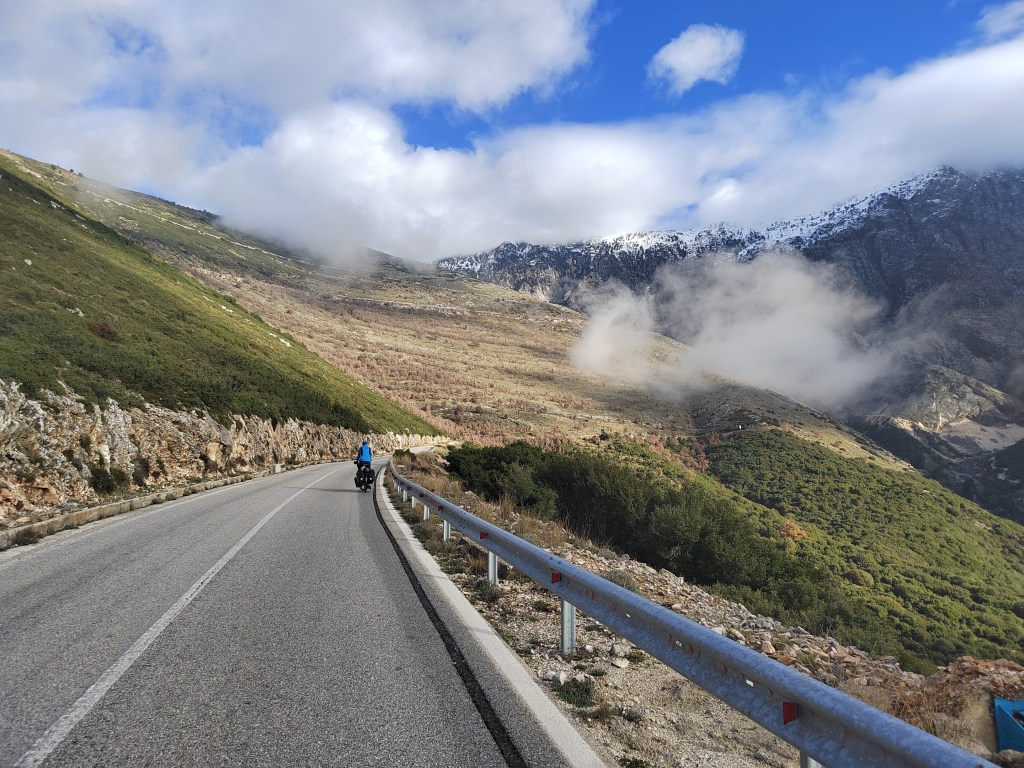
We have a sweeping descent after passing a pretty Ottoman-style village, and I’m feeling amazed and proud that we climbed this much. We pass a cyclist who doesn’t have any luggage, but is having to push his bike up the climb, which is even more validating. Near the bottom, we realise we’ve made a really bad mistake. We had trouble finding somewhere to stay tonight, and since it’s another shuttered-up seaside town we couldn’t risk just trying our luck so booked a studio in advance, picking the cheapest thing we could find without really thinking about it. Now we can see that it’s far below the main road which we’ll have to climb up again and join tomorrow, and straight away join a road up to one of Albania’s highest category mountain passes. I feel sick as we drop down a steep 600 feet, but there is nowhere else we can stay.
The climb out of town has inclines of 18%, which hurts my legs and my soul. When we get back to the main road we can see the switchbacks criss-crossing up into the clouds, but in a way it’s reassuring to be able to see and measure our progress against the mountain.
It doesn’t take long until we’re well above sea level and can look down onto the beaches and the heavy machinery marring the views. There is an unbelievable amount of building going on here. Almost as many flats are being built as in Reading, and to facilitate that the enormous construction site along the coast has its own cement works and aggregate plant. If you were thinking of coming to Albania for a peaceful, unspoilt holiday break, you are far too late.
The climb takes us over 3,500 feet, and while the day starts off clear we are shrouded in mist and cloud as we near the top. It’s a bit disappointing, since we are level now with a stunning snow-topped mountain which we can only see in glimpses. Still, we have hauled ourselves up a category 1 col on heavy bikes with full luggage, so we have to be content with the feeling of achievement. A man (in a Mercedes) pulls up beside us to encourage us and let us know that we’re nearly there. But we’re not. We arrive at a viewing platform (with no views thanks to the clouds) and assume the hard work is done. But round the next corner are another several hundred feet of switchbacks.

At first the descent is unspectacular, but when we’re almost down the trees lessen and the valley opens up and it all becomes worthwhile. The road does a full turn so we get to see the impossibly high mountain we climbed as well as the rest of the Ceraunian range.
We arrive near our overnight stop very clearly lost. A man at a cafe offers to tell us where our homestay is in exchange for some raki. When we find the house there’s a lovely garden full of fruit trees, and we’re given handfuls of lemons and oranges, and later a bag of kumquats. We have so much gifted fruit now that my panniers are completely loaded down, but there’s a kitchenette where we can turn it into juice and make it easier to deal with.
We have a short, leisurely ride to the city of Vlore coming up, so we take the time to stop for coffee at a cafe. We’re quickly joined by an elderly gentleman who sits down and orders himself a huge amount of raki while telling us how many girlfriends he has in London, and then getting annoyed that we won’t pay for his drinks. He ominously calls out “watch yourself on the roads” as we cycle away. I’m a bit rattled by it, and it’s a shame that one encounter like that can put a pall on the day, so I remind myself that we had to spend an hour juicing fruit last night because so many other people have been kind to us.
The apartment we rent in Vlore is a couple of miles out of town, but is so nice we spend a couple of days there making the most of the cooking facilities to re-fuel after the tough days through the mountains.
On our day off we ride into the city to get some laundry done and have a coffee while we wait. At the cafe we meet Nikita, a 21 year old Russian living in Albania with his Ukrainian girlfriend, having finished university in Spain and now unable to go home. He’s struggling to learn Albanian, but was employed at the cafe for his fluent English. He tells us that he likes Albania a lot, and gives us recommendations of things to see in the area. But he admits to feeling isolated with the language barrier, and over the moon to be able to have a full conversation, even if some of that is about his fear of going home despite how much he misses his family. Not for the first time we feel the luck of being born where we were, and having a passport that allows us to travel pretty freely.
From here the climbing eases and the traffic exponentially increases. The roads in Albania are worryingly narrow and the driving is interesting. But every one of them fastidiously stops at zebra crossings, which makes us feel at home. And mentioning home, in Albania telling people that you’re from the UK (everybody asks) elicits an enthusiastic and delighted response.
Our next room is behind a converted storefront, with the glass painted over and the door not quite fitted properly, which makes for an uncomfortable night in the freezing temperatures. And the room has the usual Balkan feature of being festooned with light switches with only one of them working.
We want to do at least one cultural stop in Albania, and since we missed Butrint we now take a bit of a detour to the UNESCO world heritage city of Berat. On the ride there the landscape is becoming much more industrial and polluted, but the city itself looks lovely. We have a homestay in the cobbled streets of the old town, in a small alley behind a pretty 19th century mosque. We’re greeted by a lovely old man who can’t do enough for us. He insists on feeding us breakfast in the morning. He brews his traditional çaji i malit (“mountain tea”) with local herbs, as well as “home coffee” (Turkish-style) and serves up his wife’s homemade jam. He used to work at the Onufri museum here, which specialises in liturgical artwork and other items collected from the monasteries of the region.
On our day off we visit the cathedral and climb up to the city’s castle. The views are more spectacular than the buildings, though the castle grounds are populated by villagers whose families have lived continuously here for several centuries. There are also hotels being built in and around the fortress, so I’m not quite sure what World Heritage preservation means in this case.
We want to get an early start in the morning, but our host won’t hear of us not having breakfast and mountain tea. It was already filling yesterday, but now it includes a pile of homemade doughnuts. We try to leave a few, but this won’t do. I probably look like one of The Flumps getting on a bike when we finally leave.
We always seem to route ourselves through the industrial centre of most of the countries we visit, and sure enough we spend the next few days slogging our way through the dust and smog of northern Albania, getting our fill of quarries and mining sites and the heavy traffic that brings. The days are clear and bright, but the pollution visibly hangs in the air. We cross rivers that are white, presumably with chemical pollution. There’s not much space on the roads and it’s one of the least pleasant stretches we’ve ridden so far. In the back of my mind is always the fact that every morning we see countless cafe-bars full of men drinking raki alongside their coffee, and no doubt getting behind the wheel afterwards. We pass a petrol station one day around 10 am full of lorry drivers drinking the stuff.
People in Albania have been almost unwaveringly friendly, but I can’t deny that sometimes I have an underlying sense of unease. Part of it is probably down to the tenseness I feel on the roads. But there are other things which feel odd. Everywhere is overwhelmingly full of only men. In groups on streets, in the cafes, in restaurants. Once you notice it, it’s impossible to unsee. Before I’d mentioned it to Richard he made the same observation, and that he felt a kind of overall discomfort. Neither of us can put our finger on it, and it seems really unfair because we’ve experienced so much kindness.
We head for Montenegro on the road around Lake Shkoder. There’s barely any traffic on the road. The lake is serene and the air is clear. When we get to Montenegro a Mercedes with Albanian plates pulls over and the driver asks if he can get water for us. It’s as if Albania wants us to eat our words.
A playlist for the ride:


 Ride & Seek
Leave a comment