
The overnight ferry docked in Pireaus, the port that serves Athens, in the early hours. It was still dark and the road west is a busy dual carriageway, so we set about getting round that. We found a local passenger boat that got us out of the city via the island of Salamis. By the time we were set down it was light, and cycling across the island was lovely and quiet through pine forests. There was a 5 minute boat the other side to get us back to the mainland on a tiny road through small coastal towns with stunning beaches. When we joined the main road again it was along the kind of rocky dramatic coastline with perfect blue sea I think of when imagining Greece. The roads were narrow, but there was very little traffic. I imagine this route would be a more dangerous proposition in the summer. The final third of the day was into a strong headwind, which was going to be with us heading west across Attica and the Peloponnese.

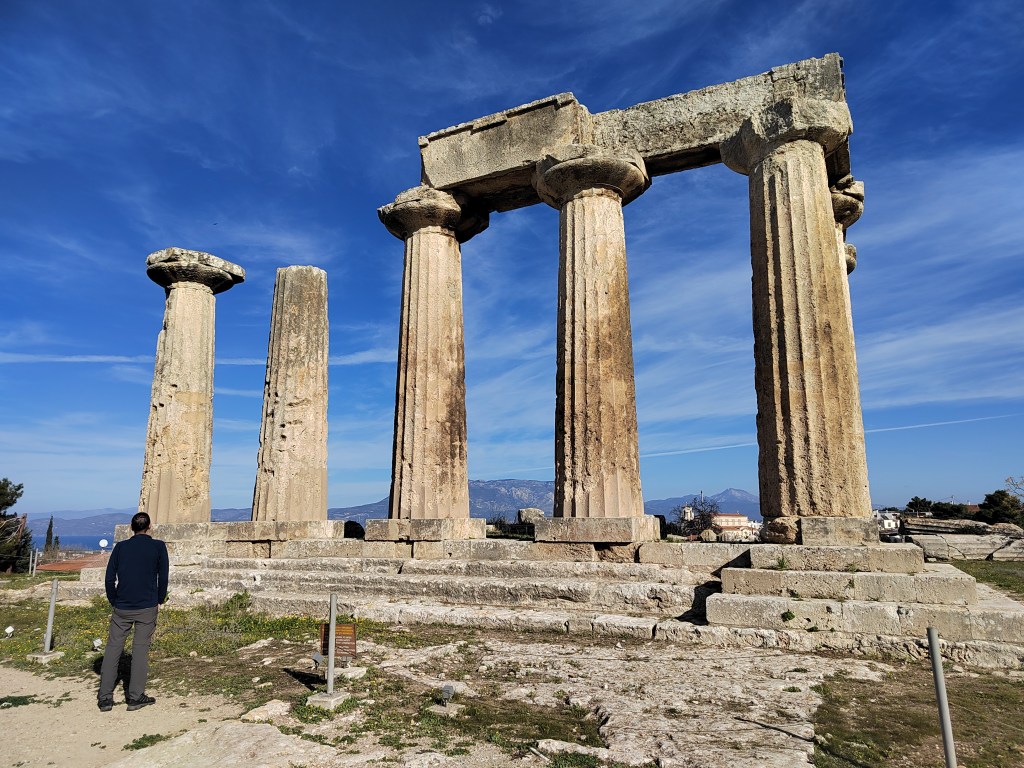
The only day off we’d earmarked in Greece was in Corinth, where there’s a medieval castle AND some ancient ruins not far from the city, so an exciting two-for-one day out for Richard. The castle/fortress was incredible, or rather the views from the top were, although I don’t think our aching legs appreciated the hiking around or the steep walk to the village and museum below. I also don’t think ancient Corinth was Richard’s favourite collection of rocks so far, but he endured.
We put our skates on and did some long shifts against the headwind in an effort to speed through Greece as quickly as possible. As always in Europe, the spectre of how long we can stay looms over us, so there needs to be a balance between making ground, taking rest and appreciating the places we pass through.
To get from the Peloponnese to the mainland there is one of the longest suspension bridges in the world, and we’d both been looking forward to riding across it. We were led to believe it had a joint cycle/pedestrian lane, but when we got there it was steep steps, followed by a turnstile and very clear “no cycling” signs. We tried the entrance to the bridge proper, but the road is very obviously a motorway. There are regular ferries across the gulf so we had to go that route. Luckily getting the ferry coincided with a hotdog stand just as I was about to get hangry. The wind was immense on the ferry, so cycling on a 1.5 mile long, 52 metre high bridge with a fear of heights was probably not a good idea anyway.
A week ago we deliberately stayed in Turkey and avoided Greece for Christmas, since everything would be either shut or incredibly expensive, but we now have New Year to deal with. At the risk of a huge generalisation, Greeks are unbelievably, unfathomably loud. I cannot think of a noisier country to spend NYE in, but as it turned out the seaside place we stayed in was otherwise empty, and it was the quietest night we spent in the country. No screaming, shouting, door slamming, jumping off beds, or inexplicably moving furniture around at 2am. It was bliss. And prior to that, as if by miracle, we found the only 3 things open in a walking radius. A cafe, where we had a great coffee after a tiring day. A tavern, with an hour until closing, so we had some hot food. And a supermarket, where we got a little bottle of wine for under a pound, and some food for the next day in case nothing is open.
We’ve been stung lots of times in Europe by things being shut on Sundays, religious days, regional holidays and random days, but in all fairness, although shops are always shut in Greece on those occasions, cafes and restaurants remain open so we’ve always been fine for food and drink. With a hot day forecast (which by my measurements is anything above 18C) that meant some disappointing Fanta. After all the time we spent in south east Asia, the European version of rationed sugar and additives is actively offensive. I like my fizzy drinks to look like nuclear waste and have the same nutritional value.
We were able to continue to make great ground as we rode north, even though mainland Greece, particularly Epirus, is brutally mountainous. I can honestly say I really enjoyed the climbing in Greece, it was usually on good roads, the temperature was manageable, the gradients aren’t too bad and the scenery rewards are just beautiful. We decided to leave the coast for a bit to take in some of the mountain areas inland. Away from the main route north near the sea, the rural roads and villages had a completely different feel. There were immediately endless people waving, kids shouting “hello,” lots of people asking where we’re from. Greeks generally have been really, really friendly and helpful, but up until now we’d had to approach them first to unlock this.

After the promised warm weather earlier in the week, the temperatures dropped pretty sharply and we had rain most days. The washing situation became desperate, as we can’t get anything dried. I was reduced to using a swimsuit for underwear and both of us were trying to keep what distance we could from other people, lest they smell our socks.
We stop in the biggest place we’ve been in since Corinth on the promise of a launderette which appears on our maps. The place is actually classed as a city, but it’s as if the apocalypse has passed through and wiped everyone out. There is not a single light on, no one on the streets, nothing whatsoever open. Certainly not the launderette. It’s baffling, but there have been other places like this and I can’t think of an explanation. Even the fact that Greeks take a late afternoon siesta surely cannot account for places being completely and utterly deserted.
After how good our progress had been, and how dire the clothes situation was, we allowed ourselves a day off in a large town. We also knew that Epiphany was the next day, and we don’t want to get stuck in a small town with nothing open. Epiphany is an important religious feast day in the Greek Orthodox calendar, and it celebrates the baptism of Jesus. The main ceremony is a priest throwing a cross into the sea, and a group of men jumping in after it. The one who retrieves the cross is blessed by the priest. The fact that this has to be done in freezing January, or that women aren’t allowed to take part, makes about as much sense as the rest of it I suppose. I can get on board for the feast part though.
Regardless of what I think of the religious aspect, it was good to witness the tradition. Perhaps non-Brits would feel the same at seeing us burning effigies on bonfires. First there was a parade through town of Orthodox priests in all their pomp with all their icons. And then the line of guys shivering in their swim shorts and probably freezing their bollocks off waiting to jump off a pier into the freezing sea. The cross wasn’t thrown very far, hopefully because the priest took hypothermia into consideration, so the competition for it didn’t last long. The guy with the cross was ecstatic, and everyone crowded round trying to kiss the cross he’d captured.
Onto the more understandable tradition of the day, we thought if we ate at mid afternoon (Greeks eat very, very late in the evening) we’d have no trouble finding somewhere, but everywhere was full and booked. Eventually, after increasing anxiety on my part, we found a little tavern off the beaten path, where we treated ourselves to a couple of jugs of wine and a feast of grilled meat. We were then brought a gift of a third jug of wine, so I ended the celebrations in my own traditional way: Completely wasted.
We were then delayed an extra day by monumental thunderstorms, and that turned out to be good timing. It turns out that the 7th January is Christmas day in the Greek Orthodoxy and very little was open, so we would have been in trouble had we left the large town.
More rain was forecast for the following day, but our feet were too itchy to stay any longer. We could see lightning flash across the sea in the distance, and hear the rolls of thunder getting closer, but we made it through most of the ride, and up the major climb, before it really did tip it down. We found an olive grove where the trees were dense enough to shelter under until the worst of it passed. After a long downhill, Richard made the silly comment that at least it only rained earlier and we have dried off now. Because of the forecast, we booked an apartment online in a small seaside place. It started to rain as we rolled into the small town, and there was an awful feeling at seeing every single building shuttered up and closed and not a soul to be seen. We found the small apartment building and tried the phone number we had to no effect. Luckily the only living person in the place had spotted us and came over to help. He called the landlady who explained that it was a mistake and the apartments were closed for the winter.
As the rain got heavier we all had to shelter in the awning of a closed down hotel, while the helpful local phoned round to see if there was anywhere we could stay. Eventually he exhausted all the options. The whole area was flooding at this point, and there was no way we could even pitch the tent. The roof above us started to leak, so we had to go on. We both agreed we could make it to the next town before dark if we left right then. The downside was that the town had only one road in/out and a 10 kilometre descent into it, which means a 10 kilometre climb back the way we came in the morning.
First up though a 15% climb of small road to get out of the mess we’re currently in. That’s too steep to ride, so there’s walking and raining and swearing for the first half hour. There’s a fast section of main road curtailed by more heavy rain, and more huddling beneath trees. The eventual descent into the town is really pretty – Greek coastline at its best, despite the worry about where we’ll sleep. Then there’s the heart-sinking feeling of another closed beach resort. We try several apartment buildings with rental signs up and several hotels, but they’re all shuttered up with doors locked. We pass a gyros place, but those are the only lights on in the whole town. It’s dark and it’s pouring with rain again. We take shelter under the awnings of a row of closed shops. Even the ATMs have been closed down for the winter. We talk about trying door handles and see if we can just get indoors anywhere in the warm. Richard walks further down the deserted street and spots a lit sign on the road above advertising rooms. A final climb nearly kills me, but a woman answers the door and she is kind and welcoming and she has a room to rent for a under the amount of cash that we have.
It’s so wonderful to be warm and dry that I forget about what awaits us in the morning. We head to the gyros place, eat our fill and then fall asleep in total exhaustion.
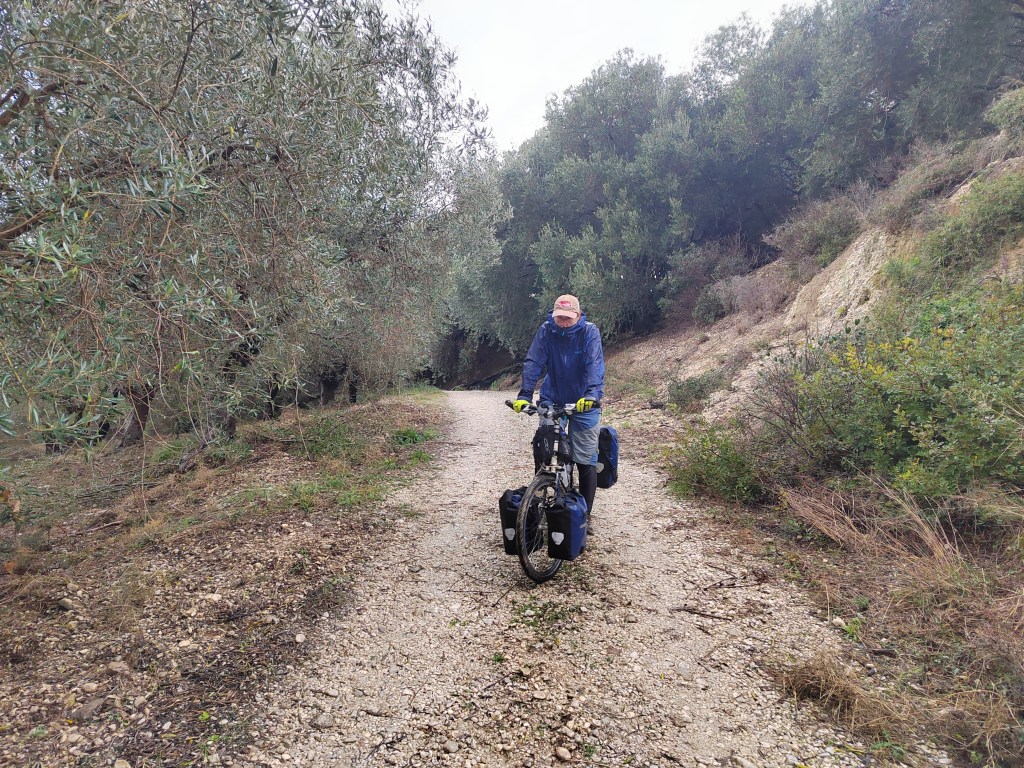
The following morning could not be more different. There is one extra place open, and it’s a bakery where we can get coffee and some cheese pastries to steel ourselves for the climb. It’s a glorious spring-like day. The climb felt very steep as we descended but on the way up is a comfortable one, framed at every turn by the turquoise Ionian sea.
It ends up being the final full day of cycling in Greece, because we turn out to be fitter than we thought and have no trouble getting close to the northern border. We stay in the port town of Igoumenitsa and find a cheap family-run hotel, where we’ve given some homemade biscuits when we arrive, and then drinks and cereal bars to see us off when we leave.
Border guards tend to be either surprisingly friendly or complete dickheads. The Greek one threw our passports at us when he’d finished checking them. The Albanian one was apologetic that we wouldn’t be getting a stamp, since all of that is electronic these days, and I’m unreasonably disappointed by that.
The road to the border with Albania was one of the quietest we’ve ridden in Greece. And as it wound through into the hills, we saw glimpses of the terrain, goats and scenery we can expect over the coming days. My legs are nervous but my heart is excited at what awaits us.
A playlist for the ride:
 Ride & Seek
Leave a comment