
Getting back from the Hinterland to the east was a bit of a landmark for us, since even though we’ve still got a long way to go it will mostly be on the same road heading north, so it does mark the last phase of riding here. On our way we had a spectacular camp spot and ride through the Toolara and Tuan state forests, both of which have populations of 0 people, which suits us really well. But its roads are narrow and they are populated by drivers. Australia is the only place we’ve ridden where we’ve encountered any hostility on the road. We’ve had some colourful things shouted as us from car windows, and the occasional person swerving to (presumably) intimidate us. It’s been a very, very small number of people, but it can really put a dampener on an otherwise great day.

The final part of our push to the east was into a headwind on a long barren road. We’ve mostly been riding with the prevailing wind and had almost forgotten what it’s like heading into one. There are times of pain when I wish the hills away, but honestly a straight flat road into a headwind is far worse and much harder mentally. I would look down at my bike computer and see that my km/hour speed matched the kilometres left to go, and agree with myself that I could manage another hour of this. Half an hour later the headwind would get stronger and I am getting more tired. And the numbers still match because I am getting slower. I admire those who cycle the Nullarbor. It’s not for me.
The next day we hit the infamous Bruce Highway, which will be our companion for a large part of our remaining time here. We have heard so much about it, and have received endless advice to avoid it (we can’t) that it had become a spectre looming over us. “The Bruce” is one of the 25 most deadly roads in the world, and claims by far the most casualties of any route in Australia, accounting for 1 in 6 deaths on the country’s roads. Fortunately we found that part out with only a few days to go on it.
Our first stop in the Fraser Coast region of Queensland was at a fairly remote spot off the highway and into some protected woods. We usually have a plan for where to get food each day, but our host meticulously wrote down a detailed map showing where we could find supplies and good coffee on our way out, the best route we could take to avoid the highway and then gave us some avocados to make sure we tried the produce that the area is known for. A couple of people stopped by at camp to give us ominous warnings about some upcoming rain. We are still constantly without any online connection, so have no idea on most days what the weather has in store for us. We gradually learned that there had been record rains in the Northern Territory and they are now heading our way. In the end we somehow avoided the worst of it, arriving in towns after it had hit or leaving just before it did. We only had to huddle down for one day, which was a great result considering it was talked of for days as a massive weather event.
The Bruce Highway became a grind pretty quickly. The ride through Central Queensland was monotonous, the road is busy and narrow, the surface is crap and the towns are fairly nondescript transit places. I did accidentally stab myself in the neck with a tent peg though, which spiced things up. And we learned the term “sausage sizzle.” We were invited to one and to watch the footy (Rugby League in this case. No other sport is relevant in this part of Australia.) It’s one of the State of Origin games between Queensland and New South Wales, which is taken incredibly seriously here, perhaps even surpassing national games in importance. We were told that there wouldn’t be any NSW fans, so we could come along and support them because “Wales is pretty much the same as England isn’t it?” I’m not sure what face I pulled as I imagined the reaction of some Welsh friends to that comment.
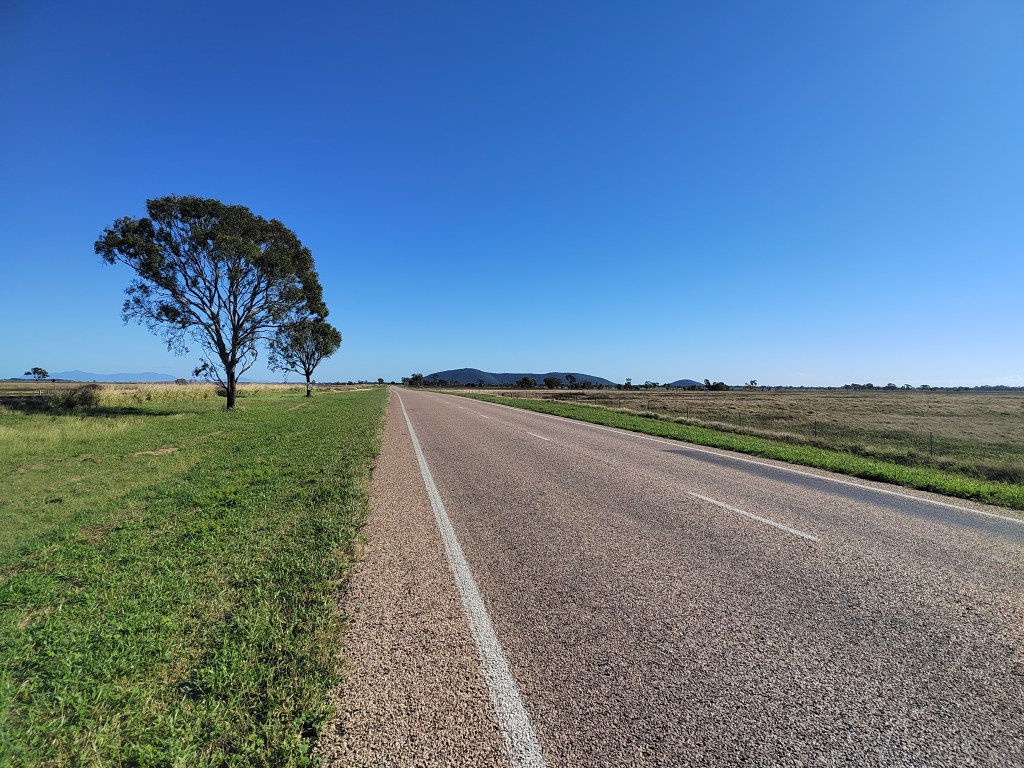
The distances between anything other than more road is amazing. The Bruce is the main artery running north/south through the State, but it’s pretty normal for there to be 50 and sometimes 80 kilometre stretches with no shops, shelters, petrol stations, houses…nothing. The great thing to come out of that was in casting around for places to stay we discovered that some country pubs allow camping on their grounds, so we took to using them as often as possible. Mostly they charge a very small fee or ask for custom in their pub (not a problem!) in exchange for a space to pitch and a warm shower, but we have also been allowed to stay for free.
The monotony of the road isn’t just an issue for us; there is a huge campaign on the highway for drivers to take a break, to the extent that the local Government puts on stalls offering free coffee at some rest stops. It’s clear by the number of crosses and flowers we pass – several per day – what a dangerous road this is. The conditions for us vary from one mile to the next. Some parts are quite wide and feel somewhat safe, but then the road can narrow and the shoulder disappear without warning. This isn’t the part of Australia for huge road trains, but still the lorries are beasts compared to the ones in Europe. Much of the highway surface is compressed chippings, which isn’t pleasant to ride on, and there is so much roadkill, broken glass and blown out tyres on the roadside that it’s impossible not to swerve around. We haven’t seen a live kangaroo in ages.
It’s not all bad. In most countries driver’s advice and perception of how flat a road is, or how safe it is to ride, is wildly off for a cyclist. But in Australia, where almost no one seems to ride a bike, people are very insightful about it. We get really thoughtful advice about where the next place to get drinks is, which way the wind is blowing, the distances between rest stops and shops, and accurate descriptions of the terrain. The bikes are also a good conversation starter, and Australians don’t need much of an excuse to meet and greet. Strangers often offer to charge our phones when they see we’re in a tent, or offer water and food. One guy gave us a few eggs to add to our dinner and some wine to have with it. Several times when we’ve got to road works with traffic lights the workers change both sets to red to make sure we get through safely.
Despite the repetitive and tedious cycling, we have been to some wonderful campsites. One particularly gorgeous spot beside the Boyne river alongside flocks of lorikeets and cockatoos. Another tucked away in the hills of a National Park with the valley looking much more beautiful from above than it does on the road. We got some food from the park cafe and after being given some of it for free, the ranger offered a glamping tent for us to use. Later that evening another ranger drove up with some firewood for us. Between the cold nights and the mosquitoes we’re usually in the tent pretty early, so it was lovely to spend a toasty evening beneath the stars. And we got a small taste of internet on British Grand Prix weekend with the news that Mercedes are nowhere, which is enough on its own to warm me through to my bones.
The signs we see along the road warning of koalas have petered out, and now we mostly just get warnings of frogs in toilets. And, unlike the koalas, we have actually seen a few of them and they do indeed inhabit toilet bowls given the chance, as well as other unwelcome places. At one stop a girl was wanting to use a camp BBQ but found a large frog under the cover so called the caretaker over who removed it. She asked him “Are they poisonous?” to which he replied “No, they’re not poisonous, but if they get upset they’ll spray some nasty venom at you.” What a fascinating idea of “not poisonous” some Australians have.
Heading to north Queensland it became really hot and started to get pretty humid, and with the concentration needed on the narrow highway and the barren landscape it made the riding nothing but a chore. We were kept company somewhat by the Cane Trains which run alongside the road. Part of this region is prime sugar cane land, and it’s transported on its own dedicated narrow gauge company rail lines. We both get childishly excited waving at them and getting a wave and a blast of the horn back. I suppose we break up the monotony of their day just as much as they do ours.

We were really wanting for a short break, but the places we’ve been to have either been completely void of anything interesting, or they are completely booked out. During the winter a phenomenon takes place which we’ve heard referred to as the Grey Migration, where it seems that all Australians over 60 from the south east travel north for several months in their caravans and motorhomes. We’ve had lots of recommendations for little towns and beaches and tourist sights to visit, but it’s impossible to find even a grass pitch at any of them, even when we try asking a couple of weeks ahead.
Despite not enjoying the riding at all, or perhaps because we weren’t enjoying it, we made really great ground up to north Queensland. We booked our flights out of Australia a while ago, with the idea to stay here until the very last day that we could. We now have very little distance to cover and a lot of time to do it. With so much time to spare, I was happily planning many diversions and side trips to see more of this part of Australia. And then the rain came. At first it forced a rest day, which was sorely needed, and the little seaside town we were in was nice enough. The next day though it poured down solidly for over 12 hours and trapped us there again. Fortunately we’d seen the forecast and chosen a proper campsite, so we did at least have a seating area which was undercover (though still open air) to hunker in. The camp permanent residents did their best to keep our spirits up, but jokes about the tent washing away started to get a bit too real at some points. We were assured by one bloke that it would stop the following day and that the next town was decent, but also mentioned that we should be careful because it has quite a lot of aboriginals, as he pulled an obnoxious face. It’s far from the first time. The offhand racism here has been really shocking, and it’s astonishing that people have felt comfortable enough to make some of their comments to complete strangers.
It rained for the next week for the most part. Any break in it we made what ground we could, but the need to dry the tent and our stuff was always a worry, and it curtailed the distances we could do. We got stuck another couple of times by torrents of non-stop rain, having to abandon the tent at one point as the area flooded. We tried to salvage something from this awful section of the ride by taking a detour to the place we’re most likely to see cassowaries in the wild. But a deluge kept us trapped part of the way there at a cafe for two hours before we had to give up. Anyway I’m sure the birds are more intelligent than us and stayed in the dry.
The stress of having to ride a dangerous road in poor visibility, sleepless nights worrying if the tent will flood, not being able to get anything dry, the mud, the mosquitoes, the leeches and missing two great boxing performances took their toll and all our enthusiasm was washed away by the time we got near our destination. I think the last stage of the cycling here has been pretty bad. Richard’s opinion is somewhat more explicit. But when we finally arrived in Cairns we both just felt relief that it was finally over. We do still have a few days in hand. Some of it is set aside for work on the bikes and the rest is for sightseeing, but our cycling time in Australia is now complete.
After the first month here I was lamenting that we’d only applied for 3 month visas, and was plotting a return visit. Our time in New South Wales was like a wonderland, and the Hinterland riding was often tough but overwhelmingly rewarding. The last bit has worn the shine off somewhat, and the cost of travelling here is astronomical. Even though we’ve camped 99% of the time and mostly cooked for ourselves, Australia has been monumentally expensive so it’s hard to imagine returning.
A playlist for the ride:
 Ride & Seek
Leave a comment